Monday, April 22, 2013

Many Bridges Crossed, Miles to Go Before We Sleep

Most of this content is reprinted from a blog  (with permission) by Miles MacFarlane. His original title was "20+ Years of EdTech."  He has taught for twenty years. I've always liked Frost's poem and somehow, it became the subject of this post. Mr. MacFarlane wrote:

I have used every one of these devices in fulfillment of my duties as a classroom teacher. These were the tools available to me since I became an educator. It makes me feel rather old, but proud nonetheless, to have mastered these valuable communication technologies for teaching and learning.

And some say today's technology is too complicated.


Want to talk about that?

Thursday, April 18, 2013

New Educational Technology Promises Joy and Faster Learning

Ed Tech Advertisement, circa ~1963
Larry Cuban, a Stanford professor, pulled together a great article which looks at the promise and attitudes towards new educational technology as revealed in the advertising.

Published on the Education Week site, it says:

For more than a century, educational technology ads have glistened with hope. Newly invented devices from the typewriter to film projectors, from the overhead projector to instructional television, from the Apple IIe to the iPad, have painted pictures of engaged students who will learn more, faster, and better. They have pictured teachers using new technologies to teach effectively. Of course, it is the nature of advertising to promise a rosier future, appealing to what policymakers, administrators, and, yes, parents yearn for ... a better, easier, and even enjoyable way for teachers and students to teach and learn. And that is what these ads do. They assure readers that both teachers and students will be better off using these machines.

Great article, well done Larry.  Note to self, need to secure an overhead projector and an Apple IIe

Sunday, March 10, 2013

Encyclopedia and Dictionary


I grew up in a house with a big dictionary on a stand and a complete set of the 1962 World Book Encyclopedia.  The actual dictionary and stand are pictured below (that's not actually me or my old house, it's my nephew at my Mom's  condo).  I recently acquired a complete World Book Encyclopedia set identical to the one that I grew up with.

When I was in school, one of the key ingredients of every classroom was a dictionary and every school library was built around its encyclopedia, atlas, and other reference works.  To this day, the accrediting institutions still list the library with its book collection and reference materials as a key issue.

World Book Encyclopedia

With a sweet sense of irony, I just looked up "encyclopedia" on Wikipedia and found:

...The beginnings of the modern idea of the general-purpose, widely distributed printed encyclopedia precede the 18th century encyclopedists. However, Chambers' Cyclopaedia, or Universal Dictionary of Arts and Sciences (1728), and the Encyclopédie of Diderot and D'Alembert (1751 onwards), as well as Encyclopædia Britannica and the Conversations-Lexikon, were the first to realize the form we would recognize today, with a comprehensive scope of topics, discussed in depth and organized in an accessible, systematic method... 

In the United States, the 1950s and 1960s saw the introduction of several large popular encyclopedias, often sold on installment plans. The best known of these were World Book and Funk and Wagnalls... By the late 20th century, encyclopedias were being published on CD-ROMs for use with personal computers. Microsoft's Encarta, launched in 1993...The 21st century has seen the dominance of wikis as popular encyclopedias, including Wikipedia among many others.
Random House Dictionary of English Language

 Encyclopedia Britannica  -- at its peak, had around 2,300 in the sales force....A year ago this week, the last salesman for Britannica, Myron Taxman, retired.  He was 66. He began selling the encyclopedia at the age of 22, when he was still in college in Chicago. He sold the volumes for 28 years: to farmers and to new parents without much money, to a Bears quarterback and to film director John Hughes.  (Encyclopedia Britannica Salesman Mourns End Of Print Edition)
Another memorable aspect of the encyclopedia era was the door-to-door salesman who sold them.  A surprising number of people of my generation spent some time selling them.

What did the standards say about using reference works and finding them with alphabetical order?

Language Arts: K
Information and Media Literacy
Research Process:
The student will:
1. ask questions and recognize the library media specialist or teacher as an information source; (LA.K.6.2.1)
2. use simple reference resources to locate and obtain information through knowledge of alphabetical order, use of pictures, and environmental print (e.g., signs, billboards); (LA.K.6.2.2)

Language Arts: 2
Information and Media Literacy
Research Process:
The student will:
1. generate research questions by brainstorming, identify key words, group related ideas, and select appropriate resources (e.g., atlases, non-fiction books, dictionaries, digital references); (LA.2.6.2.1)
2. select and use a variety of appropriate reference materials to gather information and locate information using alphabetical order; (LA.2.6.2.2)


And who can talk about reference materials and refer to media centers or libraries without going back to the card catalogs and the Dewey Decimal System.

This card catalog is proudly featured in the entryway to the Time4Learning office.

Monday, January 28, 2013

Little Golden Books

Little Golden Book, Chimpmunks' Christmas , Richard Scarry
Little Golden Books - The Chipmunks' Merry Christmas

I was sitting in my office, more or less minding my own business, when a office visitor, actually someone from an insurance company checking on our fire extinguishers and such,  mentioned that she liked my collection, especially the Little Golden Books.

 In fact, she (Beth Aroyo-Mirowsky) said that she had a collection of Little Golden Books!    It turns out that there is a whole subculture of people collecting Golden Books such as Little Golden Book Collector and  The Santis,  

Like many collections, the value seems to be that for many people, it reminds them of their youth and appeals to their nostalgia for happy days when their parents read to them..

Once I pulled my jaw back into place, I took the opportunity to pick her brain about the Little Golden Books.

Little Golden Book 1981
Western Publishing Company
We have about 50 Golden Books in my educational collection which she looked through.  There were five that she said were noteworthy and collectible.  For instance, I have a Little Golden Book called: "The Chipmunks' Merry Christmas", dated 1959.


Little Golden Book 1982
Western Publishing Company
This book seems to be noteworthy for a few reasons.  It is an early appearance of the Chipmunks (See their sweaters? Alvin, S? and T?). The price tag was $0.29.  

And the book was illustrated by Richard Scarry!

Richard Scarry,  in case you don't know, became a well-known children's author and illustrator best kown for Busy Town. He peaked in popularity in the 70s, 80s, and 90s.  I think in the 50's he was still relatively unknown although he was already 40 in 1959.

I continued to look through my collection of Little Golden Books and I became intrigued by the elaborate artwork on the back covers. 

The Golden Books back covers are amazing in a few ways including the breadth of characters represented.


 I see Big Bird from Sesame Street Productions; Mickey Mouse, Bambi, and Donald Ducks from Walt Disney; Bugs Bunny from Warner Brothers; and Smokey the Bear from....(Gosh, who owns Smokey, the US Park Service)? Here's a few different Golden Book back covers.

Golden Books was founded in 1942 and was led by the Bank Street Writer's Association which later evolved in the Bank Street School of Education.


 Here's a fun trivia question: What was the most popular of all the Golden Books?

Answer: It was not even close. There was one book that outsold all the others many times over.  At one point, it had sold more than almost all the other combined.  It 
was the story of a little puppy who was not so good at rule following. Of course, it was the Poky Little Puppy. 


Golden Books are still published today and greatly resemble the originals. They belong to Random House.

This blog also has an article about the Big Little Books, a type of book introduced in the early 1930s. And there's an article about Encyclopedias and Dictionaries (especially the World Book Encyclopedia).

Little Golden Book 1972
Western Publishing


Golden Book - Golden Press 1959
Copyright Monarch Music 


Saturday, January 12, 2013

The Polaroid Instant Camera

I'm of a certain age (mid50's!) and so I remember using Polaroids back when they were very high tech.  The excitement was that you could take a picture and look at it right away!

Somethings never change, right?  Think today's cell phones, Instagram, Twitter, and hordes of other instant tools for sharing images.

Back then, the image would slowly appear over around 90 seconds (as best I can remember) after you yanked out the paper from the camera.  It came with a four tube that had a spond in it drenched in some sort of "fixed" which we would rub over the picture once it had finished developing.  It felt very technical, high tech, and exciting.

Edward Land started the camera reportedly inspired by  his daughter who .."wanted to see the picture NOW!"  The camera and company's highlights were in the 1960-80s when it was lauded as an example of American technological and entrepreneurial prowess.  Wikipedia summarizes it as:

Polaroid Corporation is an American-based international consumer electronics and eyewear company, originally founded in 1937 by Edwin H. Land. It is most famous for its instant film cameras, which reached the market in 1948, and continued to be the company's flagship product line until the February 2008 decision to cease all production in favor of digital photography products.

Educational Technology: 2012 or 1972?


This blog of old educational technology documents my office collection of previous educational technology "revolutions."  It is both for fun and to avoid any hubris thinking that our revolution in ed tech is the one that's really going to make the difference.
Dan Meyer posted an interesting article called: Is This Press Release From 2012 or 1972?
130105_1
And I quote/paraphrase:
Here are five quotes, some from 2012 others from 1972. Can you tell them apart?
#1 Educators and parents across the country seem to agree that a system of individualized instruction is much needed in our schools today. This has been evident to any parent who has raised more than one child and to every teacher who has stood in front of a class.
#2 [This product] allows the teacher to monitor the child's progress but more important it allows each child to monitor his own behavior in a particular subject.
#3 The objectives of the system are to permit student mastery of instructional content at individual learning rates and ensure active student involvement in the learning process.

#4 This is a step towards the superior classroom, because the system includes material that can be used independently, allowing each child to learn at his own rate and realize success.
#5 The technology, training program, and management technique give the teacher tools for assessment, mastery measurement, and specified management techniques.
Okay, they're all from 1972, from a piece called "Do Schools Need IPI? Yes!" 
For the rest of the article, you'll need to go to Dan's blog post:  Is This Press Release From 2012 or 1972?
  

Friday, November 30, 2012

The Instamatic Camera

An Instamatic Camera
The Kodak Instamatic
I added an Instamatic from Kodak to my collection this week.

It is the not the first Instamatic that I ever owned. I think I was given one when I was about 12, in 1970. I remember it as the first quality inexpensive no-focus required camera. Everyone had them.

Later, I was given a more modern one which used the square lightbulbs (see below - And thanks to Wikipedia for the picture of the Instamatic in its case with the flash bulbs).


Thursday, November 22, 2012

Sunday, September 2, 2012

Filmstrips and Education

Filmstrips

Classroom record player
When I was in school, filmstrips were the height of multimedia coolness.

Many school film strips came with records so the operator would advance the film strip by one frame with each "ding."

This process be explained on each and every record meant to run along with the filmstrips.  I remember  the voice explaining that: "At this point, you should be on the frame with the filmstrip title that says (for example):  'Adjectives Describing Nouns.' If you are not on this frame, move forward or back to it at this time to that page.  During the filmstrip, you will hear some pings like this < PING > which will mean that it is time to advance the filmstrip by one frame.  Lets try it now. When you hear the ping, advance the film strip. <PING!>.  Did you advance the filmstrip?  Are you on such and such page? Well done!"
Filmstrip projector

 The techie kids were rewarded by the teachers and became AV Assistants (Audio visual assistants) who got to run the film strip projector (and the movie projectors which was a harder project). First, they would go down to the office and check out the appropriate AV cart, bring it upstairs in the elevator (reserved for teachers and special tasks), wheel it into the class, and run it.

Anybody have educational film strips for sale?  I bought half a dozen film strips a few years ago but would like to have more.

I also have an early film strip type of projector known as a magic lantern which had film strip pictures which are hand painted on glass. The light is not electric, it's an oil lamp!

The entire collection is housed in our office at LearningCity.com where elementary school teachers can get help with literacy and vocabulary from VocabularySpellingCity, help with elementary writing instruction from WritingCity.com (great implementation of Writers Workshop), and for K-2nd science from Science4Us.com.

Wednesday, February 29, 2012

1961 Mimeograph Machine by Standard Rocket

A few great things happened today.  It was the day before my birthday and the office threw a small party for me.  Per my request, we did have a general singing of Happy Birthday, we had the good singers do rendition for us.  Wow, what an improvement that is. We have four great singers in our office and it was beautiful as opposed to the usual horror when everyone, on tune or not, joins me.  BTW, I'm one of the out-of-tune singers.

Secondly, there was a big box and inside was a 1961 Standard Rocket mimeograph machine with a few dozen Copy-rite Spirit Master Units  and two standard wicks (I'm not entirely sure what they are).  The machine is hand cranked and appears to be in working order.

The mimeograph masters seem a little aged so I'm not sure that they'll work.

About the smell. Yes, the smell of the freshly printed mimeographs is of course the most important thing.  The fact is that I have bad cold today and I can't tell if the masters have the right smell or not. Stay tuned.

BTW, does anyone know what gave them that fantastic smell and how I could reproduce it?

Friday, December 23, 2011

The Macintosh by Apple

The Mac was a major milestone in modern computing including for education. I just read the 400 page biography of Steve Jobs by Walter Isaacson so I'm full of  a sense of its history.

I just got this Mac 512 SE to join the retro ed tech collection.

 I personally joined the ranks of the Apple fans when the Macintosh came out. I had been an early PC user (1983) and had not personally been on the Apple 2. I was on the PC until 1988 when I moved to California and had a Mac both at home and in the office.

I was on the Mac from 1988 to 96 when I switched to a PC oriented company.

Monday, December 19, 2011

Projectors: Movie Projectors and Slide Projectors

Happy Holidays! my colleagues yelled. There were two medium size boxes all beautifully gift wrapped.  Inside, two old decrepit projectors. I was thrilled.

The movie projector is an 8 millimeter Bell & Howell. Model 253A, Serial number  H34504. 500 watt lamp, 5 amps, 115 volt AC, 60 cycles.  As soon as I get the time, I'll try to look it up and date it (Any volunteers?).

The other projector is an Argus slide projector.

For those of you who are keeping track, this expands our projector collection considerably. We had previously featured our DeJur  and when in California at the STEM conference, I had photographed several old projectors on display at the Claremont.

I just realized that we have never truly featured our film strip projectors or our collection of film strips. Stay tuned.

Wednesday, November 2, 2011

See and Spell

 Is it a toy or an educational tool?

This clever educational device certainly predates Vocab- SpellingCity- .com.  I haven't found a date on it but I'm guessing its post WWII, perhaps the 50s.

 You get to spin the wheel and in each of the three windows, you can see a little picture.   There are maybe ten rows, three each. The pictures are of baby, toy, dog, cat, boy, girl, bone etc

You look at the word, then you try to spell the word.

Finally you open the window to see how you did. Pretty exciting, huh?

The See and Spell is similar to flash cards and a zillion other contemporary solutions to the problem that its hard to test youself on spelling.  Of course, the most contemporary solution (which I personally am troubled by) solution to the studying-your-spelling-list-problem is...to NOT give spelling tests.   Yes, the Common Core standards and associated curriculum have based their approach to word study, as best I can tell, on some research such as one study that I've heard about that shows a very LOW correlation between the ability to spell words on spelling tests and the ability to spell them in the context of writing.  Conclusion: they're dropping weekly spelling tests and weekly list-based word study.  I suspect that will be harder to accomplish than they may think.

One more thing: Thanks to Cady for the See and Spell.

Sunday, October 16, 2011

Mimeograph Machines and the AB Dick Company

One of the prizes of my colleciton is this old pre-electric mimeograph machine circa 1917. Click to read more about this old mimeograph machine. Oddly, while I do have this old one, I can't seem to find a standard electric one circa 1960s or 70s.

I've been in and out of all sorts of odd stores and even contacted the surplus people related to school districts and government agencies. I've been on Ebay with not much success.

I'm now tracking down the company that made them: AB Dick Company.   Here is a Youtube video of the dedicating of their Chicago factory in the 40s. And I quote vvickers3313 from Youtube:  This was the dedication video of the building that stood at 5700 W. Touhy in Chicago. It was converted from 16mm film, taken circa 1940s. There is no sound. This video will only be interesting to all employees who worked for this great company. 


From Wikipedia, the free encyclopedia
The A. B. Dick Company was a major American manufacturer of copy machines and office supplies in the late 19th Century and the 20th Century.
The company was founded in 1883 in Chicago as a lumber company by Albert Blake Dick (1856 – 1934). It soon expanded into office supplies and, after licensing key autographic printing patents from Thomas Edison, became the world's largest manufacturer of mimeograph equipment (Albert Dick coined the word "mimeograph"). The company introduced the Model 0 Flatbed Duplicator in 1887. Later on, the flatbed duplicators were replaced by devices using a rotating cylinder with automatic ink feed. Basic models were hand-cranked while more elaborate machines used an electric motor.
The company had a new headquarters built in 1926, the building at 728 West Jackson now called Haberdasher Square Lofts, and remained there until their move to suburban Niles in 1949.
The company virtually created the business of "quick printing" via storefront shops that printed from disposable plates on duplicators. Tens of thousands of its Model 350 and 360 duplicator were sold, many of which are still in use. Starting in the 1960s, xerography began to overtake A. B, Dick's older mimeograph technology.
John Stetson was president of A. B. Dick when he was appointed Secretary of the Air Force in 1978.
In 1979 the company was acquired by the General Electric Company (a British firm, not to be confused with the American company General Electric). In 1988 the company acquired Itek Graphix, a leading manufacturer of plate-makers for duplicators (small format offset presses). By the late 1990s it was a division of the Nesco company of Cleveland.

I've heard that AB Dick got acquired by Presstek.
I've just started reading from a site called the OfficeMusuem.com about copy machines. Stay tuned... 

Thursday, June 9, 2011

My Victrola

In March of this year, I wandered into an antiques mall (the Treasure Chest), met Fred, and bought several items including this Victrola.


I haven't taken my victrola into the office, I keep it at home. Partially because while it is old and genuine, I'm not entirely sure that it counts as something used in education.


 I think Victrolas were entirely for home entertainment and were in people's parlors, not in schools.

I gather in the early days there were two types of record players: those with external horns and those with an internal speaker. The internal speaker type are Victrolas. This one dates from around 1920.

Anybody know what the ones with the external speakers are called? I think they are record players but I'm not so sure....

The machine came with one particularly beat-up old 78 rpm records. In fact, it had a cigarette burn on it so you could play the first third. But it was a great song, it was the army fight song.

Over hill, over dale...Or is it ...

Over Here, Over there, we will hit, the dusty trail, and those cassions, go rolling along.

Monday, April 25, 2011

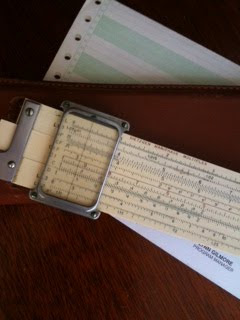
Back to the Slide Rule...53 Years Back.

Slide Rule
Slide Rule
The slide rule was, in its day, an amazing tool. In the pre-digital technology era, which by the way was when I went to high school, the slide rule was the defacto method for doing large calculations that couldn't be done by hand.

The slide rule was the tool that separated the mathematically competent from all those who couldn't quite understand the magic of the logarithmic scale.

It's amazing to think of the calculations and achievements that were done on a slide rule. World War II with all the weaponry, airplanes, radar technology, and even the atomic bomb...all developed with the help of the slide rule.

The Trident submarine, the early lasers, and Interstate Highway Program were all developed with the calculations done on slide rules.

The Gemini, Mercury, and Apollo Space Programs by NASA including the trips to the moon were calculated on slide rules

I was going through a vintage 1958 HOLIDAY magazine, and came upon this ad. It appears that a group of busy engineers and architects are engaged in the challenge of building a new urban tower.

Nothing earth-shatteringly new to report on slide rules...obviously, since this ad is 53 years old, but with a trove of vintage magazines at my disposal, I like finding examples of how education indirectly creeps into popular culture.

Here is a slide rule in an advertisement.

The image is clear, a slide rule in the hands of these men creates a smart picture of success. It helps sell brands and creates a whole image.

Today of course, the day of slides rules has passed.  An ad today would feature men with Smart Phones and they probably would have different hair cuts and shirts. But  mastery of the slide rule, in its day, was the height of a certain worldly savoir faire than stank of success and competence.


Sunday, April 24, 2011

Carbon Paper is Cool!

carbon paper
Carbon Paper is Cool!
When you enter our incredibly high tech offices, you'll find a typewriter ready to use right in the reception area. It's the same typewriter that I used through high school (I graduated from BCC in 1976) and my Dad wrote his doctoral thesis on (awarded in 1962).  Astute observers will notice that I've put in three pieces of paper and that there's a piece of carbon paper between the top two.

The reason for three sheets of paper is that my Dad taught me that it would protect the carriage and keep it from breaking. The reason for the carbon paper is to properly recreate the way I typed my papers. Photocopies were rare and expensive back then so we used carbon paper. To my delight, I bought the carbon paper right at Office Depot. Apparently, it's still in use.  Despite that, when I show it to the kids, they think carbon paper is really cool. Of course, it takes them awhile to understand it's purpose but once they do, they think it's fun and want to make a huge mess with it.


BTW, who is Kevin Laurence and why would I mention him in a post about carbon paper?  Is he the inventor of carbon paper? No, he is not. Sadly, we don't know for sure who the inventor of carbon paper is but thanks to Kevin, I know this about the origins of carbon paper. And I quote from Kevin's The Exciting History of Carbon Paper!  


  The exact origin of carbon paper is somewhat uncertain. The first documented use of the term "carbonated paper" was in 1806, when an Englishman, named Ralph Wedgwood, issued a patent for his "Stylographic Writer." However, Pellegrino Turri had invented a typewriting machine in Italy by at least 1808, and since "black paper" was essential for the operation of his machine, he must have perfected his form of carbon paper at virtually the same time as Wedgwood, if not before (Adler, 1973). 


Kevin tracks the prehistory of carbon paper in its role supporting the love affair between Pellegrino Turri and the beautiful but blind Countess Carolina Fantoni, (I'm not making this up! But you'll have to click through for that story).  Kevin describes the big breakthrough of carbon paper:

By 1823 Cyrus P. Dakin of Concord, Massachusetts, was making carbon paper similar to Wedgwood's, and selling it exclusively to the Associated Press. Forty-eight years later, the same Associated Press was covering the balloon ascent of Lebbeus H. Rogers; a promotional stunt in Cincinnati for the biscuit and grocery firm of which Rogers had just been made a partner. During an interview in the newspaper offices after the flight, Rogers happened to see Dakin's carbon paper and immediately saw its commercial potential for the copying of office documents. The firm of L.H. Rogers & Co. was immediately founded in New York, and in 1870 achieved its first major sale ($1,500) to the United States War Department (Sheridan, 1991). However, it was not until 1872 and the development of a practical typewriter for commercial office use (the Sholes and Glidden typewriter), that Rogers' vision was proven correct.

And The Typewriter Provided The Perfect Application

For the first time a good copy could be produced at the same time as a good original.

Tuesday, April 19, 2011

So many levels of technology

I thought I'd include a picture that I took during my time as a Peace Corps Volunteer in Cameroon (West Africa) in 1980-82.  At that time, the towns had running water and electricity (for the rich) and telephones that rarely worked. The  villages, where maybe half of the population still lived, had no telephones, electricity, or running water.

I hear that the rural schools still look this way.  But somehow, they do have working cell phones with Internet access almost throughout the country. Go figure.

The schools mostly had chalkboards, desks, benches, and a few books. A few years ago, I contributed heavily to a project to get a library of books (think several bookshelves) into thirty rural schools in Cameroon.   Isn't it odd to envisage these technically primitive schools co-existing in my world of being constantly wired, and in several ways!

Congrats to Jeff, Melanie, Jason, and Andrew

I just read a fantastic article about the history of educational technology. It's called The Evolution of Classroom Technology on a blog called Edudemic.com.

The article  is really a catalog of educational breakthroughs with short comments It makes some similar points about education and technology. Essentially, we feel today  that we are in the middle of a revolution in education due to technology. We are not the first to feel this way.  They base the article on a few Source(s): New York Times, History of Things, Wikipedia.


Since the article is so fantastic, I'm feeling a tad defensive.  You see, it's a fantastic timeline.  My blog is meant more of a catalog of my own collection, it's not trying to be a comprehensive timeline.  Which is good.  Since the team at Edudemic has totally won the race to produce a great comprehensive timeline.  Well done.  Very useful and interesting.

Tuesday, April 5, 2011

Mimeograph Machines

I have powerful and fond memories of the smell of the blue ink on the mimeographed copies that were used in my K12 schools.

 I haven't yet located a mimeograph that would have been in use in the 60s and 70s (my school days) but I was recently given this much more valuable and older mimeograph machine.

HELLO - If your school or church has an old mimeograph machine around, particularly if it's working order, please contact me (via SpellingCity.com) since it would really help round our collection.

The mimeograph machine that I have is from just after the turn of the century.  It is labelled:


Edison's Rotary Mimeograph
 No. 76. 
Made by A. B. Dick Company, Chicago Illinois

There are a list of patents going back to 1897.

The machines that were used in the 1960s into the 80 were by the Standard Rocket company.

Here for instance is a manual version of the machines that I remember in the schools

 It is a 1961 Standard Rocket mimeograph machine with a few dozen Copy-rite Spirit Master Units  and two standard wicks (I'm not entirely sure what they are).  The machine is hand cranked and appears to be in working order.


About the smell. Yes, the smell of the freshly printed mimeographs is of course the most important thing.  Does anyone know what gave them that fantastic smell and how I could reproduce it?

 This blog highlights vintage educational technology which have been collected in the VocabularySpellingCity office such as My Victrola,  school desks, Golden Books, Dictionaries and Encyclopedias,  and film strips .

Take a peek at the cutting edge technology of yesteryear.