Thursday, July 23, 2020

Education: Sing a Song for Reading

 Tim Rasinski is a renowned professor of literacy education whose research on reading fluency and word study has made him a literacy hero to many. Below, he shares his thoughts on using song and music to teach reading. 

“Some days there won’t be a song in your heart.  Sing anyway.” — Emory Austin

Tim Rasinski shares his thoughts on using song and music to teach reading. 


A few months back, my two-year-old grandson, Alex, was invited to a kid’s party. Alex is generally shy and somewhat reserved. However, once the song “Baby Shark” was played, Alex went right up to the small stage at the front of the room and, on his own, began to dance and sing for the rest of the children and adults. (I must admit, Alex has some dance moves that he needs to teach his grandpa). What a delight to see this toddler be so inspired by the music, to (without any prompting) perform in front of a large group of kids and adults, most of whom he did not know.   

What this episode demonstrates to me is the power of music and song to add joy to the human experience and to show the potential for using music and song as vehicles for teaching – especially reading. Music and song can add so much to any classroom.

  • Music and Song are Fun – School should be an enjoyable experience for children. Most children (and adults) can find great joy in music and song. My daughter, who is getting married later this year, insists that the “Chicken Dance” and “YMCA” be part of the playlist for the reception. Sixty years later, I can still remember taking delight in singing “Oh Susanna” and “Polly Wolly Doodle All Day” in my own elementary school classroom. How about you?
  • Music and Song Create Community – One of our roles as teachers is to help children learn that they live in a community larger than themselves – their families, places of worship, classrooms, schools, etc. Music and song help bring us together as communities. The patriotic songs that we hear on national holidays, as well as our school anthems, help to develop that sense of common purpose that helps to define a community.
  • Music and Song Reflect Culture and History – So much of one’s culture and history is embedded in the songs we sing. Think of “Yankee Doodle” from the American Revolution, or the “Battle Cry of Freedom” from the Civil War, or “Over There” from the First World War. But beyond wars, songs can reflect, and even amplify our culture and history. When teaching about the Civil Rights era, how can we not expose our students to “We Shall Overcome” or the many other songs of that time? Similarly, the Great Depression was a time for songs to uplift the American spirit – think “Happy Days are Here Again” (and of course the darker side of such times as reflected in “Buddy Can You Spare a Dime”).
  • Music and Song can Lead to Reading – Song lyrics are a form of written text available for reading instruction that often gets forgotten.  The very nature of songs and song lyrics make them especially well-suited for reading. Songs have rhythm and melody (a form or prosody for you fluency folks) that make them memorable. How often have you seen the bobbing heads and swaying bodies of children as they sing a favorite song?  Why as children, on the night before an important test, did we put the information we wanted to retain into the melody and rhythm of a familiar song or poem? The words in songs can be the gateway to building sight vocabulary. Sight words are, at their essence, memorized words – by sight and sound. By introducing words to students in the context of memorable songs (make sure the words are visible to the students), we provide them with a joyful first encounter to words that will eventually be recognized by sight.
  • Song Lyrics for Children Rhyme – Rhyming words are, for the most part, made of what we in reading call rimes (or word families or phonograms). Teaching rhymes/rimes can be a very powerful way to help children gain proficiency in phonics. Learning “me” and “knee” from “Oh Susanna” will help children cement the  “-e/ee” rime in their minds and lead to other words such as “be,” “he,” “we,” “bee,” “see,” “tee.” “Row Row Row Your Boat” contains the words “stream” and “dream.” The “-eam” word family can lead children to learn to decode “beam,” “cream,” “seam,” “steam,” “scream,” “team.”

Teachers who do find ways to make songs a more integral part of their curriculum are usually pleased with the results. For example, first grade teacher Becky Awasaki has her students learn and rehearse several songs each week. They then celebrate what they have learned each week with an end-of-the-week sing-a-long with invited family and friends. She shared with me after a year of bringing songs back into her classroom, “I have never seen so much progress in reading. All my first graders are reading at or above grade level – and they love to sing!” Her students were singing and taking great delight in songs for sure, but because the written lyrics were always in front of her children, they were reading as well.

Songs and song lyrics offer so many ways to make literacy instruction (and schooling in general) so much more joyful, varied, and effective. Moreover, with the advent of the internet, access to song melodies and lyrics for children have never been easier. So let’s certainly keep a poem in our pockets, but also let’s keep a song in our hearts – and in our classrooms!

Some Great Websites for Children’s Songs

Also, visit my website where I have posted some songbooks we use in our own reading clinic program (Camp Read-A-Lot).    

_________________________________________

Tim Rasinski is a professor of literacy education at Kent State University. His research on reading has been cited by the National Reading Panel and has been published in journals such as Reading Research Quarterly, The Reading Teacher, Reading Psychology, and the Journal of Educational Research. Read more about Rasinski here, or connect with him on Twitter @timrasinski1.  


Friday, February 7, 2020

Editing Film, Old Style

It's hard to believe but until around 25 years ago, every single film was edited together by hand on machines like these.


The process was careful to maintain film quality since each generation of copy, back in the analog days, was worse than the original.

So the original film footage was copied and then the original was left in a vault.  The copy was cut and spliced together over and over again until the editor and director were pleased with the result. Then, the time stamps were carefully noted and the original film was spliced together. And from that original, the copies for distribution were made.

To be honest, I went through this process myself with video tape but never with actual film. And I can't imagine how the audio track was handled since there has always been sound effects and audio work added to the original shoot.

The book with all the tricks for doing title for films is a real shocker. There's all the plans for building a system to hold the camera and do a "zoom" into the title. Or to have the title appear to scroll past.


Monday, July 22, 2019

Architectural Drawing Tools

I have vivid and fond memories of drawing in math class using a compass, protractor, and ruler.  Do kids still do that?  These memories are mixed with others of drawing accurate pie charts by hand while working in my mid 20s. I know nobody does that anymore: all graphs are now computer created.

Look what I was given this weekend.  It's a set of architectural drawing tools for precise work. I know that there's a compass, I'm not sure what the other tools are called or really, exactly what they're for.


This was Lester's drawing tools during his time as an architecture students in the mid 70s as the University of Miami.  A small embossed company name is on the leather package.


The first search results on Stellar Drawing Instruments shows that there is an active Ebay market in such things. A little more searching reveals an article on AmericanHistory.si.edu about these types of instruments. This is referred to as a flat case or pocket case and then the maker (Steller), number of instruments, and model might be listed.  Would this be a Stellar DS4 12 Instrument Flat Case?

I'm going to go get my glasses and study this a little more but I'll post it right now so I can maybe solicit some guidance on what it is. I'm also now curious about pre plastic rules and protractors.


Saturday, October 6, 2018

Speak n Spell and More Spelling Technology

Here's what we have in the Retro Collection:

There's the Speak N Spell from the 1970s which we remembered thanks to its role in the Toy Story Films.  I have a complete post on Speak n Spell and I have both the Speak N Spell and the Math cousin who was usppose to teach the math facts.

Speak and Spell
Speak and Spell

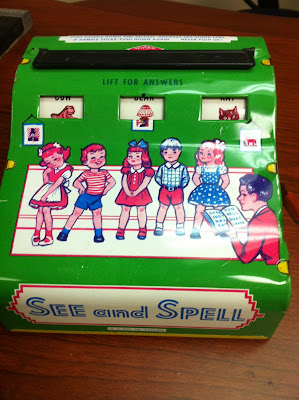
I also have a See and Spell. And I quote my See and Spell article: I haven't found a date on it but I'm guessing its post WWII, perhaps the 50s.

 You get to spin the wheel and in each of the three windows, you can see a little picture.   There are maybe ten rows, three each. The pictures are of baby, toy, dog, cat, boy, girl, bone etc

You look at the picture of the word, then you try to spell the word.

Finally you open the window to see how you did. Pretty exciting, huh?


See and Spell
See and Spell
I also have an array of old spelling textbooks and how tos that cover spelling. I'm never quite convinced that I should be amassing these old books since if I start, there is an infinite supply of them. Yick. Here's two.
Spelling texts

Should I add the original cover page of SpellingCity too? I guess I will. Here it is, circa
August 2009. (see the modern vocabularycity?)


And here's more info on the Speak N Spell and the Math N Spell
In terms of fun learning, here's more on The Phonics Game and other classics


Saturday, September 22, 2018

Mary Poppins: A Magic Lantern in the Nursery

I was watching Mary Poppins aboard a flight the other day and during the number starting with:

In every job to be done, there is an element of fun.
Find the fun and snap, the jobs a game....

And a"  spoonful of sugar makes the medicine go down...

Which takes place in the children's nursery, I suddenly noticed a detail that had escaped me for so many years. There is clearly a small magic lantern on a shelf in the nursery.  Take a look:


Here's a close up:


Want to know about using a magic lantern or the history of magic lanterns?

And here's a picture of my magic lantern.

Magic Lantern Lit
Magic Lantern Lit


Want to see a Victorian Era style school desk from my collection?

Sunday, March 4, 2018

Morse Code

The telegraph with Morse Code revolutionized long distance communications in 1800s.  Coupled with the railroad, it launched the modern network era which directly led to the Interstate Highway System, the telephone system, and today's Internet.

My Dad used and knew Morse. I know:

dot dot dot dash dash dash dot dot dot (SOS).  

For my birthday, I received my own Morse Code set (thanks Diane and Brian).

Morse Code Signaling Outfit

I'm sort of surprised that there's no more websites and apps dedicated to allowing us to experience the beauty of Morse Code. Well, there's a project!

Vintage Cameras

While today's youth might be unfamiliar with taking pictures with a dedicated camera, I can well remember black and white cameras, Polaroid cameras, Kodak Instamatics, bellows cameras, flash bulbs, and even developing and printing lack and white photos.  And my collection is full of these. In fact, it got enriched by two new cameras in the past week.

These are Polaroid cameras before the Polaroid became synonymous with instant photography.


Selfies weren't so practical with the old technology....
John Edelson selfie
John Edelson Selfie


The Polaroid Instant Camera.


Thursday, March 1, 2018

Magic Lantern

Magic Lantern Lit
Magic Lantern Lit!
The magic of light!  The Magic Lantern. In our office, we have what is known as a Magic Lantern! We fired it up this week.

Photons travelling through the air creating an image of a place, a time, where in most cases, it would not have been possible to travel to or see without the help of a Magic Lantern.

No need to rub this lantern and make a wish to be transported to a new dimension.

We take a lot for granted in the 21st century. Roll back time just a couple of generations to the middle of the 18th century one would see teachers using a Magic Lantern to transport their student to a place outside their classroom. Today, it’s the Internet, along with cell phones, iPads, tablets but in those days a different but special set of tech tools were required.

In order to create photons with enough lumens to create an image one would have to burn fuel. (Certain fuels burned brighter than others but that is a whole different subject). 
The light from that fuel would be shine onto a convex mirror to concentrate the light and reflect it through a lens that would project the filtered image onto a screen (in most cases a wall). 

In the following pictures (each picture tells a thousand words) we show you the technology behind the Magic Lantern along with images of what is required to make that technology function correctly.

Enjoy and truly appreciate what we have today!


Please Note that some items were substituted i.e lighter, scissors, newer bottle of parafin fuel and such


Want more information our  Magic Lantern?

Saturday, February 17, 2018

The Cootie Game

 I can remember  that my cousin and I called it the ant game and in my version, the head and the body were the same color and the legs, antennas, and eyes were yellow
                                             one of my colleagues (Kim) when she saw my new purchase from Ebay.


The Cootie game was marketed as an 'Educational Game Suitable for All Ages."  It was pretty popular when I was a kid in the 60s. It seemed like every family had one.


The Cootie Game was a turn-based game that could be played with up to four players. The goal was to build assemble all the parts into a complete free standing  plastic bug - a cootie. Created by William Schaper, Cootie went on the market and was a huge hit 1949 (Was there a wood version originally or was it always made out of plastic?). In 1973, Cootie was acquired by Tyco Toys, and, in 1986, by Milton Bradley which was part of Hasbro.  It continues to be available in stores.


There were other cootie games sold by other manufacturers but only this one went big time.  Does anyone know anything about the origin of the word "Cootie"?


Wikipedia reports that: The earliest recorded use of the word "cootie" appears in Albert N. Depew's World War I memoir, Gunner Depew (1918): "Of course you know what the word 'cooties' means....When you get near the trenches you get a course in the natural history of bugs, lice, rats and every kind of pest that had ever been invented."[5] The word may be derived from Malaysian kutu, a head louse.[6] In North American English, children use the word to refer to a fictitious disease or condition, often infecting members of the opposite sex.[7] 

It continues...In 1948, Minneapolis, Minnesota postman William H. Schaper[8] whittled a bug-like fishing lure he believed had toy potential, and sold it (and others like it) in his store as a sideline to his homebound business of manufacturing small commercial popcorn machines.[9][10]Eventually, he created a game around his creation, and, in 1949, molded it in plastic and formed the W. H. Schaper Mfg. Co. Inc..[1][9]
Schaper offered Dayton's, a local department store, several Cootie sets[2] on consignment[9] and the game proved a hit,[2] selling 5,592 by the end of 1950.[10][11] By 1952, Schaper's company sold 1.2 million Cootie games,[9] and thereafter, a million games a year.[2]

Other Cootie Games (also from Wikipedia)...

Cootie Game, ca. 1915
Schaper's game was not the first based upon the insect known as the "cootie". The creature was the subject of several tabletop games, mostly pencil and paper games, in the decades of the twentieth century following World War I.[9] The Cootie Game fashioned by the Irvin-Smith Company about 1915 was a hand-held game that involved tilting capsules into a trap[9] over a background illustration depicting a WWI battlefield. In 1927, the J. H. Warder Company of Chicago released Tu-Tee, and the Charles Bowlby Company released Cootie; though based on a "build a bug" concept similar to Schaper's, both were paper and pencil games.[9] In 1937, Rork's released The Game of Cootie, and it too was a paper and pencil game.[9] A paper and pencil party game called Beetle is popular in Britain but its date of origin is unknown. In 1939, Transogram published Cootie, a game featuring a three-dimensional wooden bug assembled in a die-cut tray.[9] Schaper's game was the first to employ a fully three-dimensional, free-standing plastic cootie.[9]


Tuesday, November 14, 2017

Vintage Paymaster Series S-1000

Guest blogger Jenny here! I work for VocabularySpellingCity and took my father-in-law on a tour around the office.  As he admired all of the retro educational technology in the office, his immediate reaction was "Wow! This is a walk down memory lane...".

Smiling faces greeted him along the way as he met most of the office staff. His second, and most noted, observation was the pleasant work environment. He shared that observation with colleagues, friends, and family for days to come.

That evening, he called to tell me that he had a vintage Paymaster machine from Paymaster Corp that could use a good home. Being born in the 1980's, I had no idea what a Paymaster machine was, but the excitement in his voice was contagious, so I told him to dust it off and we would adopt it.

Vintage Paymaster Series S-1000

This Paymaster machine was used by my father-in-law to process payroll from 1982 - 1999. The equipment originated from Paymaster Corporation, a Chicago-based company. 


Some of you may have the same question that I did, "Why is this machine superior to a simple ink pen?" A Paymaster machine was used to validate the integrity of a check. As you can see in the images below, the text is raised - almost like a notary seal. 


This provided added security to prevent fraudulent checks. 

The Paymaster Series S-1000 still had its original dust cover, which displayed a warning to beware of unauthorized personnel.

"Only a Paymaster distributor displaying a currently dated identification card is permitted to inspect, service, or renew the Paymaster two year Warranty. Do not void your Paymaster Warranty by allowing unauthorized personnel to service your Paymaster."


My father-in-law was happy to see that his payroll machine found a new home with fellow retro technology pieces.  Thank you for donating your piece of history to us, Tom!