Friday, December 23, 2011
The Macintosh by Apple
I just got this Mac 512 SE to join the retro ed tech collection.
I personally joined the ranks of the Apple fans when the Macintosh came out. I had been an early PC user (1983) and had not personally been on the Apple 2. I was on the PC until 1988 when I moved to California and had a Mac both at home and in the office.
I was on the Mac from 1988 to 96 when I switched to a PC oriented company.
Monday, December 19, 2011
Projectors: Movie Projectors and Slide Projectors
The movie projector is an 8 millimeter Bell & Howell. Model 253A, Serial number H34504. 500 watt lamp, 5 amps, 115 volt AC, 60 cycles. As soon as I get the time, I'll try to look it up and date it (Any volunteers?).
The other projector is an Argus slide projector.
For those of you who are keeping track, this expands our projector collection considerably. We had previously featured our DeJur and when in California at the STEM conference, I had photographed several old projectors on display at the Claremont.
I just realized that we have never truly featured our film strip projectors or our collection of film strips. Stay tuned.
Wednesday, November 2, 2011
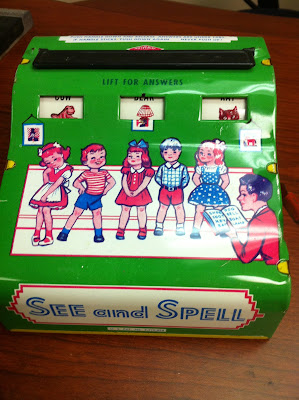
See and Spell
This clever educational device certainly predates Vocab- SpellingCity- .com. I haven't found a date on it but I'm guessing its post WWII, perhaps the 50s.
You get to spin the wheel and in each of the three windows, you can see a little picture. There are maybe ten rows, three each. The pictures are of baby, toy, dog, cat, boy, girl, bone etc
You look at the word, then you try to spell the word.
Finally you open the window to see how you did. Pretty exciting, huh?
The See and Spell is similar to flash cards and a zillion other contemporary solutions to the problem that its hard to test youself on spelling. Of course, the most contemporary solution (which I personally am troubled by) solution to the studying-your-spelling-list-problem is...to NOT give spelling tests. Yes, the Common Core standards and associated curriculum have based their approach to word study, as best I can tell, on some research such as one study that I've heard about that shows a very LOW correlation between the ability to spell words on spelling tests and the ability to spell them in the context of writing. Conclusion: they're dropping weekly spelling tests and weekly list-based word study. I suspect that will be harder to accomplish than they may think.
One more thing: Thanks to Cady for the See and Spell.
Sunday, October 16, 2011
Mimeograph Machines and the AB Dick Company
I've been in and out of all sorts of odd stores and even contacted the surplus people related to school districts and government agencies. I've been on Ebay with not much success.
I'm now tracking down the company that made them: AB Dick Company. Here is a Youtube video of the dedicating of their Chicago factory in the 40s. And I quote vvickers3313 from Youtube: This was the dedication video of the building that stood at 5700 W. Touhy in Chicago. It was converted from 16mm film, taken circa 1940s. There is no sound. This video will only be interesting to all employees who worked for this great company.
The company was founded in 1883 in Chicago as a lumber company by Albert Blake Dick (1856 – 1934). It soon expanded into office supplies and, after licensing key autographic printing patents from Thomas Edison, became the world's largest manufacturer of mimeograph equipment (Albert Dick coined the word "mimeograph"). The company introduced the Model 0 Flatbed Duplicator in 1887. Later on, the flatbed duplicators were replaced by devices using a rotating cylinder with automatic ink feed. Basic models were hand-cranked while more elaborate machines used an electric motor.
The company had a new headquarters built in 1926, the building at 728 West Jackson now called Haberdasher Square Lofts, and remained there until their move to suburban Niles in 1949.
The company virtually created the business of "quick printing" via storefront shops that printed from disposable plates on duplicators. Tens of thousands of its Model 350 and 360 duplicator were sold, many of which are still in use. Starting in the 1960s, xerography began to overtake A. B, Dick's older mimeograph technology.
John Stetson was president of A. B. Dick when he was appointed Secretary of the Air Force in 1978.
In 1979 the company was acquired by the General Electric Company (a British firm, not to be confused with the American company General Electric). In 1988 the company acquired Itek Graphix, a leading manufacturer of plate-makers for duplicators (small format offset presses). By the late 1990s it was a division of the Nesco company of Cleveland.
I've heard that AB Dick got acquired by Presstek.
I've just started reading from a site called the OfficeMusuem.com about copy machines. Stay tuned...
Thursday, June 9, 2011
My Victrola
Monday, April 25, 2011
Back to the Slide Rule...53 Years Back.
Nothing earth-shatteringly new to report...obviously, since this ad is 53 years old, but with a trove of vintage magazines at my disposal, I like finding examples of how education indirectly creeps into popular culture. Here a slide rule, in the hands of able bodied men, creates a smart picture of success, and ultimately helps romance and sell a brand.
Sunday, April 24, 2011
Carbon Paper is Cool!
When you enter our incredibly high tech offices, you'll find a typewriter ready to use right in the reception area. It's the same typewriter that I used through high school (I graduated from BCC in 1976) and my Dad wrote his doctoral thesis on (awarded in 1962). Astute observers will notice that I've put in three pieces of paper and that there's a piece of carbon paper between the top two. The reason for three sheets of paper is that my Dad taught me that it would protect the carriage and keep it from breaking. The reason for the carbon paper is to properly recreate the way I typed my papers. Photocopies were rare and expensive back then so we used carbon paper. To my delight, I bought the carbon paper right at Office Depot. Apparently, it's still in use. Despite that, when I show it to the kids, they think carbon paper is really cool. Of course, it takes them awhile to understand it's purpose but once they do, they think it's fun and want to make a huge mess with it.
The exact origin of carbon paper is somewhat uncertain. The first documented use of the term "carbonated paper" was in 1806, when an Englishman, named Ralph Wedgwood, issued a patent for his "Stylographic Writer." However, Pellegrino Turri had invented a typewriting machine in Italy by at least 1808, and since "black paper" was essential for the operation of his machine, he must have perfected his form of carbon paper at virtually the same time as Wedgwood, if not before (Adler, 1973).
Kevin tracks the prehistory of carbon paper in its role supporting the love affair between Pellegrino Turri and the beautiful but blind Countess Carolina Fantoni, (I'm not making this up! But you'll have to click through for that story). Kevin describes the big breakthrough of carbon paper:
By 1823 Cyrus P. Dakin of Concord, Massachusetts, was making carbon paper similar to Wedgwood's, and selling it exclusively to the Associated Press. Forty-eight years later, the same Associated Press was covering the balloon ascent of Lebbeus H. Rogers; a promotional stunt in Cincinnati for the biscuit and grocery firm of which Rogers had just been made a partner. During an interview in the newspaper offices after the flight, Rogers happened to see Dakin's carbon paper and immediately saw its commercial potential for the copying of office documents. The firm of L.H. Rogers & Co. was immediately founded in New York, and in 1870 achieved its first major sale ($1,500) to the United States War Department (Sheridan, 1991). However, it was not until 1872 and the development of a practical typewriter for commercial office use (the Sholes and Glidden typewriter), that Rogers' vision was proven correct.
And The Typewriter Provided The Perfect Application
For the first time a good copy could be produced at the same time as a good original.Tuesday, April 19, 2011
So many levels of technology
I hear that the rural schools still look this way. But somehow, they do have working cell phones with Internet access almost throughout the country. Go figure.
The schools mostly had chalkboards, desks, benches, and a few books. A few years ago, I contributed heavily to a project to get a library of books (think several bookshelves) into thirty rural schools in Cameroon. Isn't it odd to envisage these technically primitive schools co-existing in my world of being constantly wired, and in several ways!
Congrats to Jeff, Melanie, Jason, and Andrew
The article is really a catalog of educational breakthroughs with short comments It makes some similar points about education and technology. Essentially, we feel today that we are in the middle of a revolution in education due to technology. We are not the first to feel this way. They base the article on a few Source(s): New York Times, History of Things, Wikipedia.
Since the article is so fantastic, I'm feeling a tad defensive. My blog is meant more of a catalog of my own collection, it's not trying to be a comprehensive timeline. Which is good. Since the team at Edudemic has totally won the race to produce a great comprehensive timeline. Well done. Very useful and interesting.
Tuesday, April 5, 2011
Mimeograph Machines
I haven't yet located a mimeograph that would have been in use in the 60s and 70s (my school days) but I was recently given this much more valuable and older mimeograph machine.
HELLO - If your school or church has an old mimeograph machine around, particularly if it's working order, please contact me (via SpellingCity.com) since it would really help round our collection.
The mimeograph machine that I have is from just after the turn of the century. It is labelled:
Saturday, March 26, 2011
Writing on Slates
Sunday, March 13, 2011
Filmstrip & Film Projectors and STEM Education & Technology
I was struck by the fact that most speakers were very optimistic about the potential for a positive transformation of education through technology. The conference, held in conjunction with the NSTA (National Science Teachers Association) Annual Conference in San Francisco was held at the Claremont in Berkeley and appropriately, the hallways were decorated with retro technology. For instance: this old filmstrip projector was called a Delineascope and is marked Property of Fowler High School. It was made by the Spencer Lens Company of Buffalo New York and is Number 6634.
Right next to it was an old film projector.Unfortunately, my cell phone picture of it is not adequate to make out the manufacturer or item number.
I appreciated the juxtaposition of spending the days discussing how the Ipads and Android smart phones and other amazing new devices were full of potential to transform education while we had examples of previous transformations sitting in the hall.

Reflecting a bit on the question of technology and education. It's too easy to be optimistic and believe that technology in of itself is transformative. Similarly, it's too easy to be cynical and say that technology makes no difference, it's all about teachers. My thought is that:
- Schools should not feel hopelessly out fashioned and in many cases, todays schools really feel to students like a visit to a museum. This makes it hard for them to take the schools seriously when they know more about technology and the "real world" than their teachers.
- It's hard for schools, just like it's hard for people and businesses, to stay current on technology. It's moving fast and it's hard to keep up. This question alone merits a lot of conferences and investment.
- The nature of work and tools is changing rapidly and surely, the schools should have as one goal that they provide graduates ready-to-work in todays world. Doing research and "science" today is heavily dependent on technology. Yes, there are still beakers and field work but there is a lot of computer aided analysis of organic molecules and remote sensing data of geology.
- Technology can transform education about science. There are films and games and websites which have had and will have phenomenal impact. But at the end of the day, it's not the gee whiziness of it, it's the content and the activity and the "teaching" that they provide or facilitate.
Wednesday, March 9, 2011
Old Spelling Books & Readers
These were among the textbooks used in the first small schools. They went in sequence and the vocabulary got progressively challenging. They included simple lessons that often taught morals and values. Most of the examples gathered between myself and John are from the mid 19th century to the turn of the 20th.
We enjoy finding like-minded people who savor these old tomes too. My friend Sharon, who used to be a teacher, gets it. She tells me, "There is something very comforting about old textbooks. When I find these books at the flea market, usually for one or two dollars, I sort of hyperventilate the way some women do when they find a great pair of shoes."
When I last visited Sharon, we combed through her bookshelves. She took out an English book that belonged to her father. Published in 1924, the "Century Collegiate Handbook" was given to Inek, when he arrived in the U.S. after WW II. Sharon adds, "As far back as I can remember he has always loved books and reading and that has been passed on to me."
Saturday, February 26, 2011
Found an Old Schooldesk
I was wandering around a local antiques mall yesterday and spent a considerable amount of time chatting with an old guy asking how he got started selling antiques. I had already checked out his booth and hadn't seen anything of interest. But after about 30 minutes with him, I noticed something under a box and asked him (Fred) about it.Bingo, jackpot! It was an old school desk which is one of the items I've been searching for over the last year. It could date from anytime between the 1950s back into the 1880s. I base this on the fact that are there are two spots for inkwells, a feature that disappeared in the 60s as ballpoint pens and cartridges for fountain pens replaced traditional fountain pens that were loaded by filling them directly from ink bottles.
Also pictured are two other items that I found: an old blackboard that students would use at their seats and a school lunchbox talking about the US going metric. The student blackboard feels really old to me, perhaps around 1900. It was obsoleted by the introduction of reasonably price paper and pencils. I can date the lunchbox without taking such wild guesses, it says right on it: "c 1976 King-Seeley Themos Company". Of course, we all know that the US failed in its modernizing and internationalizing effort to move to the metric system which is one of the many disadvantages that we carry with us as our educational and economic system struggle to keep up and compete in the modern world. We failed at it because in the short-run, it was hard. Shame on us!
Monday, February 21, 2011
The Viewmaster
The Viewmaster was developed in Oregon by a company named Sawyer's. Like the stereoscope, it afforded 3D viewing, but because The Viewmaster used full color Kodachrome film rather than printed postcards, the images were crisper.
Originally the Viewmaster focused on geographic and scenic imagery. Our grandparents were world travelers and they made sure to bring the world to our fingertips. My sister remembers flicking through Rome; I was rather impressed with Hawaii. Jody says, "I guess at the time without cable or Video or DVDs I was hungry for images that included broader scopes of the world."
Later on, stills from popular TV shows and children's stories were included. Hands down, my sister and I loved the Barbie reels the most. But we also liked Laugh In and Dark Shadows.
Thinking back, my sister liked the privacy of the whole viewing experience a la Viewmaster. I, however, remember that we'd argue about whose turn it was to look through and pull the trigger. For the most part though, we shared nicely, passing the Viewmaster between us, and commenting on the decor of Barbie's home.
Monday, February 14, 2011
Technology du jour: The DeJur
When the Mayor of Spelling City saw it, he didn't recognize it as one of his own dusty doohickeys. He promptly asked his team about it. Someone said, "The cleaning lady brought it a few nights ago." The curious mayor stayed late one evening to ask her about it.
The cleaning woman said the projector was "junk from her attic," but after seeing all machines in the office, thought she would add to the collection. The mayor smiled, thanked her, and handed her an appreciative cash token.
The projector was last seen in good company high up on a shelf.
Wednesday, February 9, 2011
Return of the Slide Rule
After Terri wrote to me, I remembered that another dear friend, Charlotte, was the daughter of an engineer. I emailed Charlotte and asked if she might have any fond slide rule memories. I caught my friend and fellow writer on the verge of a deadline, but she responded regardless. "My dad had various size slide rules all over the house, in their little cases, and I was fascinated with them but never saw him use one!"
And since we're on the subject, just one more photo. This circular slide rule is also part of Vocabulary SpellingCity's permanent collection of educational technology. And with that I conclude my portion of this blog devoted to the logarithm-loving device that I will surely never know how to use.
Wednesday, February 2, 2011
The Polaroid
Polaroid cameras offered immediate gratification. Before digital photography revolutionized picture taking, Polaroid film produced results quickly and allowed us to see our marvels as well as our mistakes. Used in work and for fun, the Polaroid enjoyed a reputation as the ultimate party camera.
Invented by Edwin Land, and first sold in 1948, images started developing inside the camera and then continued for another minute once outside. The familiar mechanism sounded and spit out a murky image which, after some arm waving back and forth, went from fuzzy to fine before our eyes. Little did we know back then, that waving it dry was completely unnecessary.
This diagram was printed in The Golden Handbook "Photography: The Amateur Guide to Better Pictures (copyright 1956 by Simon & Schuster). The handbook is co-authored by two University of Illinois professors, one of education and the other of science education. In the forward they write:
"Photography, in just a century, has become a great medium of communication. It is a universal language, equally effective whether its task is factual or fanciful, scientific, artistic, or recreational."
Regarding photography and photographic equipment in the 60's and 70's, Vocabulary SpellingCity's mayor and techno-collector remembers, "We took pictures with cameras that had flash bulbs. The Polaroid was incredibly cool back then. I remember when the Instamatic arrived and you could 'point and shoot.' Today, that all sounds unbelievably quaint!"
Monday, January 31, 2011
The Slide Rule
Here are two slide rules. I don't know how they work. John, the Mayor of Vocabulary SpellingCity used a slide rule in high school physics and chemistry. He says, "I used to use it pretty well."
I visited The International Slide Rule Museum to find out what "using it well" would mean, but the answer was beyond my comprehension. I went to my personal library and perused The Young People's Science Encyclopedia from 1966. I thought, for sure, I'd get it since I am already an adult.
There, a slide rule is defined as:
"a mechanical instrument for doing mathematical problems more easily -- mostly multiplication and division. It consists of movable pieces of wood containing logarithmic scales and matching antilogarithms."
I was still lost. I can't remember what a logarithm is and the amount of energy I would need to spend in order to relearn it, could perhaps power a small village. The right side of my brain is limited compared to the left.
I'd be much obliged if someone could enlighten me just a smidge by completing the sentences below:
A slide rule is handy if an engineer needs to ________________.
An architect might use a slide rule to calculate ________________.
The easiest task you can do with a slide rule is ________________.
It was cool when we used the slide rule to figure _______________.
I asked John if he wore the slide rule in his front shirt pocket as a symbol of mathematical wizardry. I had fond visions of the stylish engineering geeks at my alma mater sporting pens and other pocket-size tools. He did not, but kept his in his book bag.
Tuesday, January 25, 2011
The Boston Champion Saves the Day
As a substitute teacher and homework-supervising mom, I have witnessed much pencil sharpening -- both successful and frustrating, both annoying to the ear and disruptive to the class, and always messy. In between the cheap dollar sharpener that lurks in each student's desk or crayon box and the loud electric sharpener that breaks much too often, lies this classic vintage hand-operated Boston Champion.
To tout the simple, no-nonsense merit of the Boston Champion and other similar manual metal sharpeners, I'd like to tell a little story a la Goldilocks and the Three Bears...
Goldilocks often went to the Three Bears' house to do her homework. She and Baby Bear would do their math independently, and then later compare answers. One day, Goldilocks arrived early at their cottage in the woods. The bears were still out foraging, but the headstrong girl with shiny blond hair, made herself at home anyway.
Goldilocks sat down in the kitchen and took out her work. She reached inside her knapsack for a pencil. The first one she found had a broken tip. She reached back in and pulled out a second. Its point was dull. She stuck her head in the bag and found no others. "Oh, I do hope the Bears have a pencil sharpener!" Goldilocks exclaimed.
She walked over to the kitchen counter with pencils in hand. She first found a big black electric sharpener. "This must be Mr. Bear's," Goldilocks thought. She stuck the first pencil in and the hungry machine chewed the pencil to bits, nearly taking her finger with it.
She opened a drawer, and found a small sharpener inside that was shaped like a nose. "This must be Baby Bear's," she laughed and stuck the second pencil up one nostril for that is where the blade was cleverly concealed. She spun the pencil round and round and heard the familiar abrading sound. When she took the Ticonderoga out of the nostril, the pencil was annoyingly pointy only along one side. She put it back in and after several more revolutions heard the crunch of broken graphite. "This just won't do," she said, with a droplet of discouragement in her voice.
She walked toward the window, hoping the Bears might be in sight. She did not see them, but she did spy a Boston Champion sharpener on Mama Bear's desk. She approached the device, and inserted the remainder of the second pencil into the hole. Goldilocks turned the hand crank 7 times for good luck. The Boston Champion honed the tip perfectly. It was just right and Goldilocks blurted out, "Woo hoo!!!"
According to the curators at The Early Office Museum, Boston brand mechanical sharpeners emerged on the scene 100 years ago. There were many models; the Champion was just one. Plenty of vintage ones abound on eBay. Pricing starts below $10.
Tuesday, January 18, 2011
The History of Educational Technology
That Sound of Music
In 2010, John Edelson's big holiday gift was a phonograph. The Newcomb Audio Products record player was a present from his wife. “Since John got interested in old educational stuff,” she says, “it’s gotten really easy to get him gifts.”
John took his new old phonograph to work, and instantly incorporated into his office décor. He also played it for the Time4Learning staff at the next meeting. Jennifer Eaton has been working on shaping this homeschool curriculum with John for five years, and has witnessed his collection grow. She confirms, “He gets very excited when he gets a new addition. So excited that he shows us how it works, and how it was made, etc.”
I wasn’t present at the phonograph’s debut show-n-tell, but was eager to listen to its sound. I wanted to hear the familiar crackling static that has the power to transport me back to 1973 in the pink shag carpeted bedroom that I shared with my sister. Or even to the oak entertainment console where my mother stored her many Burt Bacharach albums.
I turned the knob on John's record player, and very carefully placed the needle onto the record. After a revolution or two at 45 RPM’s, I heard that nostalgic crackle followed by the super sweet voice of the female singer. What was a delight for me was a fright for my fourth grader. Sammi covered her ears and hastily pleaded, “Ooh mom, turn that off. That’s scary.” She said the singer's voice reminded her of a clip from a horror movie that she once saw.
Now it’s your chance to listen……….
STAY TUNED: John’s record collection
Sunday, January 16, 2011
Walk in Peace
Martin Luther King, Jr. was born on January 15, 1929. Today we are celebrating him. I interrupted my daughter and her friend in the middle of a game and asked, "Why do we celebrate Martin Luther King?" Here are snippets from their response:
"He made it so everyone can be together... He changed our lives so blacks and whites can go to the same schools, same bathrooms and same shoe store...so black people don't have to sit in the back of the bus...he had a dream for blacks and whites to be together."
They spoke passionately and elaborated about the time he and his father went into a shoe store and refused to sit in the designated section, and then were sent out without being able to buy shoes. I love how girls remember this story and feel the injustice when it comes to not being allowed to buy the shoes of your choice.
We are grateful for Martin Luther King's courage and conviction. Because of him and other noteworthy predecessors and followers, most of us can peacefully walk in the shoes of our choice and anywhere we desire.
Wednesday, January 12, 2011
JUST MY TYPE
John’s early portable Smith Corona has already starred in a former blog, but I felt the desire to revisit the topic, and to praise this machine from my own point of view.
Growing up, we had one typewriter in our house. It sufficed. My mother, who had been a secretary, was an excellent typist. The only other device with a keypad was a new push-button Princess phone.
I learned to type in high school on a portable typewriter in Ms. Lentz’s typing class. She would put on a Beatles record, and the class would tap along to the beat. I specifically recall flourishing to “Maxwell’s Silver Hammer.” In those days (I am referring to the very early 1980s) we didn’t pick up the skill out of necessity to communicate efficiently with our friends via text or IM. Typing back then was an acquired and valued skill that could land a good typist a nice administrative job.
A few more thoughts about this universal icon with timeless appeal...
I think old typewriters are romantic. Movie set designers know this well, and use these bygone machines in period dramas or when depicting passionate, sentimental writer types. My vote for the most romantic use of an old-fashioned typewriter is in Baz Luhrmann’s "Moulin Rouge." The story takes place in early 1900s Paris, where a penniless Bohemian writer falls in love with a captivating yet terminally ill courtesan. Armed with an Underwood, the writer/poet taps out a love story, with plenty of internal struggle, in a light-filled dilapidated garret.
I think old typewriters can be a bit scary too. Screenwriters know this well, and have equipped some of the nastiest screen villains with them. Criminals have a notion that they are less likely to get caught if sending machine-made ransom notes or threats. In “The Jagged Edge” for example, lawyer Teddy Barnes is smitten with the man she is defending of murder until she discovers a Smith Corona hidden (not very well) in his closet. She quickly feeds the paper around the platen and types, “He is innocent.” The “t” is raised in exactly the same manner as the “t” in the anonymous typed notes she has been receiving throughout the trial. Teddy takes the machine, makes a speedy exit, and later despairingly tells her deceitful and murderous lover, “I found the typewriter.”
I think there’s always a way to recycle cool old things like typewriter parts. Jewelry designers know this well, and repurpose the graphic keys to make stylish bracelets, earrings, cufflinks, and pendants. I have a bracelet that reads “edit.” A close friend of mine who is an Adjunct Professor, clinical psychotherapist, and appreciator of the past has a set of typewriter key earrings. When she bought the pair, it brought her back 50 years. In Professor Deborah Grayson’s own words:
“I used to love the sound of the clicking and tapping of the ‘stadium seating’ keys on the vintage, black Remington of the 1960's as my Mom would masterfully type out our term papers in high school- zing! zing! zing! All of the sounds of the keys tap dancing were sheer music, especially the zip, zip, zip of the paper carriage moving the words up and out of the typewriter. I can only imagine how she would've tweeted, blogged or texted! She was fast. I remember that in those days, she typed 180 words per minute. I love keeping those memories close...”
(this last photo was taken by me while watching "Moulin Rouge" for the 87th time.)
Monday, January 10, 2011
FINDING RELEVANCE IN STUFF
Last summer I accepted a freelance writing position at Time 4 Learning, the online educational publishing company. I visited the Ft. Lauderdale office and met founder John Edelson. He is very engaging. His enthusiasm for learning is quite contagious, and yet as I sat there trying my darnedest to focus on his words, I was distracted by his stuff.
There, up on the ledge just beyond John’s desk was an array of vintage technological gadgetry. I snuck numerous glimpses at the projectors, microphones and cameras that loomed overhead. As I sat in the company of this homeschool curriculum entrepreneur, not only had I just made the acquaintance of a fellow educator, but I had met another nerd junker!
In the vast world of rediscovering the past, John and I both gravitate toward teaching tools and collectibles. We may hunt for different looking objects, yet the realm of educational toys continually attracts us. I find the iconic graphics of classroom flashcards and colorful counting cubes and tangrams irresistible, and he is pulled more toward the manly world of machines.
The continual “march of technology,” as John puts it, is a topic he enjoys pondering. Over a year ago, John revived this blog as a platform to showcase his collection, to document the ever changing tech landscape, and to discuss how it has impacted learning in school and at home. The best laid plans, however, were derailed by a Time 4 Learning growth spurt, which John, as father of the site, was responsible to nurture.
That’s where I come in…a freelance writer (who loves ellipses as you will see), stylist, crafter, and substitute teacher who believes in sneaking in learning when it is least expected. In my world, that means nonchalantly filling a cocktail table bowl with vintage vocabulary cards, turning a cemetery stroll into an impromptu arithmetic lesson, and using a new recipe to explore fractions. I relish bridging the gap between the need to learn and the desire to have fun. I don’t think any child leaves Epcot without acquiring some geographical knowledge.
I am picking up where John left off, dusting off some more of his relics, and sharing bits from my own stash as well. But before I plow full steam ahead, I need to revisit that fabulous Smith Corona….
Tuesday, October 26, 2010
About Older Than Retro
This blog, like its topic, has some history. It's purpose and authors have shifted around a few times. I won't review it all now. Suffice to say that I invite hobbyists to maintain it and am sometimes only loosely involved in the content.
To be above-board, I'll disclose that this blog belongs to the Mayor of VocabularySpellingCity.com. The Mayor (my name is John) also created:
A online service teaching writing online! Time4Writing.com. There are online eight week tutorials for students in high school, middle school, and elementary school (students must be in 2nd grade). The course is popular as an afterschool supplementary program and with homeschool families where the parents (usually Mom) is ready for a little reinforcements in giving feedback to the kids and developing their writing. The courses are run out of an online website and students to the work whenever it fits into their schedule. Roughly three hours of study is required per week. The students have the same teacher through-out the course which is highly motivating. Upon request, the courses can be accelerated which is often requested to fit test prep or vacation schedules.
A Homeschooling Curriculum website. Time4Learning.com. Online automated learning for kids from preschool to eighth grade. The service is also widely used as a supplementary skills sharpener or for summer study.
The leading vocabulary and spelling service online: Vocabulary SpellingCity.com. Enter your own lists, find popular lists posted by others, or use the sites teacher resources with materials such as compound words, homophones, Dolch Words, and more!
A great vocabulary building website that teaches analogies and idiomatic English and so much more!.
And some others. It should be understood that this is, among other things, a type of advertising.
Of course, it's based on one of my hobbies and interests. Which I enjoy. I hope you do too.
Thursday, October 8, 2009
The Typewriter that got me through high school

I'm fascinated, as was my father, by how technology changes the world around us. I've decided to use this blog to discuss.
Here for instance, from the attic, is the typewriter that I used to write my high school papers. It's a Smith Corona. There's a printer ribbon which can set to type in red. I suppose eraser ribbons might have also existed for this type of typewriter although I never had one.
To erase, I used either an eraser (if I was using erasable paper) or white tape.
The return key that you see on the computer keyboards is an echo of how we use to hit the silver return bar at the end of the line. The next generation electronic typewriters, which I used in college, had a Return Key.
I graduated from high school in 1976. The hands in this picture are those of my daughter who thought this was really cool. The kids love the typewriter. And when I showed them carbon paper (which is the next post), they really thought it was cool.
Friday, October 31, 2008
Mighty Aphrodite
If you use mighty as in "I'm mighty glad to see you," it will either date you, as someone who actually worked on the original Foghorn Leghorn comics, make you sound Southern, but cheesy Southern, not the cool Southern that you would like to be, or make you sound stupid.
The only way you could convincingly use the expressive mighty is if you are writing for a network television show and you write a line to be said by someone who is rescued out of, say, a well, right before a cliff-hanging commercial break, as in:
Brock wipes the two inch layer of mud from his eyes, reaches for his cowboy hat, and says, "I'm mighty glad to see you!"
Otherwise, keep mighty to be used as an adjective when describing something of great power, skill, strength, or force, such as Aphrodite
Tuesday, October 28, 2008
Material Girl
It does not mean "to take place or to happen."
So, when you say"the party never materialized," you are just plain wrong, and should have been home reading fine literature that night instead of worrying about some silly party.
Saturday, October 25, 2008
Mannish Boy
Manly signifies of or becoming to a man, man-like, and also manfully. Mannish means masculine, or suitable to a man. We characterize a brave and courageous man as manly and a woman's masculine attire as mannish.
Sunday, October 19, 2008
A Likely Pet Peeve
Likely. Liable. They are not interchangeable. Really. And liable is not a fancy way to say likely, and no, it doesn't make you sound more Southern. You won't be increasing your grammatical status or your cool by saying liable when you mean likely.
"He's not here today, but he's liable to be in tomorrow." This is wrong. Say instead, "He's not here today, but he's likely to be in tomorrow."
Liable is used chiefly with regard to answering the consequence of an act that is likely to be the cause of trouble; as in, "The arrest of one who exceeds the speed-limit is likely, and may render him liable to a fine."
Thursday, October 16, 2008
Am I Idle or Lazy?
Idleness describes the state of one given to empty, vain, or useless effort. It does not mean inaction, but the absence of useful action. This differs from laziness, which is indisposition to exertion, indolence, or a state of sluggish inactivity.
I supposed laziness is a moral step-up from idleness, as laziness can be a temporary state or a habit which can be corrected, while idleness seems to me to be more of a permanent state or character flaw.
This is open to debate. Your ideas?
Monday, October 13, 2008
Knitted vs. Knit
No, no, a thousand times no.
"The stockings were knit with care by Grandma."
If you speak this way you might as well have putted your sippy cup on the table, you are So Very Preschool.
A more common use of this phrase might be, "The stockings were knit with care by a lead-laden machine in China." In any case, a dollar fine for misuse of this verb would be fair.
Friday, October 10, 2008
Don't "Kid" Around
It can mean a baby or young goat, which is the original meaning of the word. It also is used as a verb meaning "to tease or joke around with" or as a noun for a child.
Although I don't object to the use of the word to describe a light joke, I do prefer to call a human child a child, and a young goat a kid.
I try not to say, " I have to go pick up my kids" as I like to identify with humans, not cloven-hoofed creatures with slitty pupils.
Tuesday, October 7, 2008
Jealousy, Envy, Suspicion
Jealousy fears to lose what it has, envy is pained that another should receive what it wants for itself, and suspicion is directed toward one who has the power and/or the will to hurt another in some way.
Rival suitors are jealous of each other; competitors are suspicious of each other's good faith.
Do not say that you are jealous of your neighbor's new wood floors, when you are really full of envy.
You may however be jealous of your teenage son's basketball skills when he begins to beat you in four out of five games when you used to regularly trounce him.
You may receive a suspicious package in the mail, but do not look suspiciously upon your neighbor's new wood floors unless you are a police officer and you think the floors may be stolen.
Instead, keep yourself commandment-clean and look on the floors with admiration.
Wednesday, October 1, 2008
Labor
Here is a quote that helps explain it:
"Of all the wastes, the greatest waste that you can commit is the waste of labor. No man minds work or its being hard if it comes to something. Perhaps you think "to waste the labor of men is not to kill them?"
-- John Ruskin, Work
Sunday, September 28, 2008
Let's Settle Farther and Further Right Now
Is the store farther or further down the road?
This one is easy.
Farther actually means "more distant" or "more advanced."
Further indicates "additional" or advancement to a greater degree, as in time.
The store is farther down the road.
You read further into the textbook.
Question:
Do you farther or further your education by reading further into the textbook?
Let me know.....
Friday, September 26, 2008
A Lurid, Livid Little FYI
Please distinguish it from livid, which means black and blue, ashen, or lead-colored.
Livid does not mean angry and lurid does not mean lewd, or sexually vulgar.
So the child molester doesn't give a lurid smile, unless he is bathed in yellow light. What he probably gives is a lewd smile, or perhaps a leering glance.
And you should probably describe your mother as "furious" rather than "livid" when you break her favorite crystal vase, unless you drop the vase on her head, in which case she might indeed be black and blue.
Lay Lady Lay
Here is how you remember when to use lay and when to use lie:
Lay requires a direct object and lie does not. You lie down on the big brass bed. You lay your guitar down on the big brass bed.
If it is a person getting horizontal by himself, it's lie, if a person is putting something down, including another person, it's lay.
Just to completely befuddle you, you use lay for the past tense of lie, as in "Last night I lay down and went to sleep." And as a past participle, you would say, "Last night I had lain down to go to sleep, when I heard a noise."
Now, to take it a step further, it is also not uncommon to hear lay as past-tense for laid, as in, "He lay the package down on the table." This is wrong.
Say instead, "He laid the package down on the table."
If Mr. Dylan had known this, he might have gotten laid more often but then again, we wouldn't have the wealth of Mr. Dylan's songs to clutter up open mike coffee houses around the world.
Thursday, September 25, 2008
A Pronounciation Niblet
Regarding the suffixes "-ive" and "-ively," know this: these suffixes are frequently mispronounced, especially in the words positive and positively. In traditional American English speech, they are pronounced pos' i-tive and pos' i-tive-ly.
Avoid pos- i-tive'-ly if you don't want to sound like a roob.
Monday, September 22, 2008
English Pronounciation in a Nutshell
I love this poem. I'd like to give the author credit, but s/he is unknown. If you are anything but a native English speaker, you may have trouble with it. Native English speakers, be honest and let me know if you had a perfect run-through. Non-native English speakers -- good luck with it! Feel free to comment. I may post a recording of it at some point.
Multi-national personnel at North Atlantic Treaty Organization headquarters near Paris found English to be an easy language ... until they tried to pronounce it. To help them discard an array of accents, the verses below were devised. After trying them, a Frenchman said he'd prefer six months at hard labor to reading six lines aloud.
Dearest creature in creation,
Study English pronunciation.
I will teach you in my verse
Sounds like corpse, corps, horse, and worse.
I will keep you, Suzy, busy,
Make your head with heat grow dizzy.
Tear in eye, your dress will tear.
So shall I! Oh hear my prayer.
Just compare heart, beard, and heard,
Dies and diet, lord and word,
Sword and sward, retain and Britain.
(Mind the latter, how it's written.)
Now I surely will not plague you
With such words as plaque and ague.
But be careful how you speak:
Say break and steak, but bleak and streak;
Cloven, oven, how and low,
Script, receipt, show, poem, and toe.
Hear me say, devoid of trickery,
Daughter, laughter, and Terpsichore,
Typhoid, measles, topsails, aisles,
Exiles, similes, and reviles;
Scholar, vicar, and cigar,
Solar, mica, war and far;
One, anemone, Balmoral,
Kitchen, lichen, laundry, laurel;
Gertrude, German, wind and mind,
Scene, Melpomene, mankind.
Billet does not rhyme with ballet,
Bouquet, wallet, mallet, chalet.
Blood and flood are not like food,
Nor is mould like should and would.
Viscous, viscount, load and broad,
Toward, to forward, to reward.
And your pronunciation's OK
When you correctly say croquet,
Rounded, wounded, grieve and sleeve,
Friend and fiend, alive and live.
Ivy, privy, famous; clamour
And enamour rhyme with hammer.
River, rival, tomb, bomb, comb,
Doll and roll and some and home.
Stranger does not rhyme with anger,
Neither does devour with clangour.
Souls but foul, haunt but aunt,
Font, front, wont, want, grand, and grant,
Shoes, goes, does. Now first say finger,
And then singer, ginger, linger,
Real, zeal, mauve, gauze, gouge and gauge,
Marriage, foliage, mirage, and age.
Query does not rhyme with very,
Nor does fury sound like bury.
Dost, lost, post and doth, cloth, loth.
Job, nob, bosom, transom, oath.
Though the differences seem little,
We say actual but victual.
Refer does not rhyme with deafer.
Foeffer does, and zephyr, heifer.
Mint, pint, senate and sedate;
Dull, bull, and George ate late.
Scenic, Arabic, Pacific,
Science, conscience, scientific.
Liberty, library, heave and heaven,
Rachel, ache, moustache, eleven.
We say hallowed, but allowed,
People, leopard, towed, but vowed.
Mark the differences, moreover,
Between mover, cover, clover;
Leeches, breeches, wise, precise,
Chalice, but police and lice;
Camel, constable, unstable,
Principle, disciple, label.
Petal, panel, and canal,
Wait, surprise, plait, promise, pal.
Worm and storm, chaise, chaos, chair,
Senator, spectator, mayor.
Tour, but our and succour, four.
Gas, alas, and Arkansas.
Sea, idea, Korea, area,
Psalm, Maria, but malaria.
Youth, south, southern, cleanse and clean.
Doctrine, turpentine, marine.
Compare alien with Italian,
Dandelion and battalion.
Sally with ally, yea, ye,
Eye, I, ay, aye, whey, and key.
Say aver, but ever, fever,
Neither, leisure, skein, deceiver.
Heron, granary, canary.
Crevice and device and aerie.
Face, but preface, not efface.
Phlegm, phlegmatic, ass, glass, bass.
Large, but target, gin, give, verging,
Ought, out, joust and scour, scourging.
Ear, but earn and wear and tear
Do not rhyme with here but ere.
Seven is right, but so is even,
Hyphen, roughen, nephew Stephen,
Monkey, donkey, Turk and jerk,
Ask, grasp, wasp, and cork and work.
Pronunciation -- think of Psyche!
Is a paling stout and spikey?
Won't it make you lose your wits,
Writing groats and saying grits?
It's a dark abyss or tunnel:
Strewn with stones, stowed, solace, gunwale,
Islington and Isle of Wight,
Housewife, verdict and indict.
Finally, which rhymes with enough --
Though, through, plough, or dough, or cough?
Hiccough has the sound of cup.
My advice is to give up!
Friday, September 19, 2008
Jangle and Jar
Historically, jangle is discord, and jangling is wrangling or babbling. Jar, however, is a clashing as of opinions or interests. Jangling disconcerts or discomposes us: jarring produces conflict, causing us to clash the one with the other, thus producing ill-will where good nature should prevail.
I'm not being sexist, just using this sentence as an example: A nagging woman can destroy the peace and happiness in her home by jarring her husband, and an irritable host may jangle his company by ill-humor.
Modern use of these two words include use as descriptions for sound. Jarring is a harsh, rough, irritating sound, and jangling is described as a harsh or discordant sound such as "keys jangling in a pocket."
Let's not limit the use of these two good words. Use the older versions -- it's more fun, which is why I often put on my spectacles to find my trousers.
Tuesday, September 16, 2008
Grammar-Globulin
The phrases "It is I" and "It is me" have long been the cause of controversy.
Little Billy visited his grandmother and was standing in front of her dressing mirror, saying, "Yes, that's me."
"Billy," said his grandmother, "You should say "That is I.""
Little Billy said, "Well it may be I, but it looks like me."
Little Billy was right in his conclusion. for me is the object of the preposition unto understood.
In the vernacular, both "It is I" and "It is me" are used, and "It is me" finds greater favor with the masses. But many grammarians are against it. They insist that one must always say "It is I," never "It is me," and that the same course must be followed with every personal pronoun following the verb to be, and in apposition with its subject. That's right. It's an appositive. Remember that from high school?
This same sort of error is commonly made with such phrases as "She is better looking than me," in which, if the elliptical verb were supplied, the correct construction would readily be seen to be "She is better looking than I (am)."
Does this make sense? Let me know.
Saturday, September 13, 2008
Have and Have Known
"The bank was closed. Had I have known it, I wouldn't have bothered to drive down there."
Or worse, "The bank was closed. Had I of known it..."
Close your jaws all the way. Grit them together hard. Now, grind your teeth until you get a headache. That's exactly how I feel when I hear this phrase several times per week.
Please, keep me out of head gear! Simply say instead, "The bank was closed. Had I known it, I wouldn't have bothered to drive down there."
Wednesday, September 10, 2008
Clean Up Your Use of Guest
By definition, all guests are invited, therefore an "uninvited guest" is also pointless, and an oxymoron, to boot.
Refrain from use of either of these phrases and I'll give you a gold star on your grammar star chart.
Sunday, September 7, 2008
Improving Grammar One Step at a Time
Improve your speech and writing with this simple phrase trick:
Instead of saying or writing, "He went on to say, " or, "He goes on to say," simply say or write, "He continued, " or, "He continues..."
It sounds slightly more formal, slightly more educated, and uses fewer words. What's not to love?
Now if only I had a grammatical equivalent of fruit cocktail to add to the grammatical Jello.....
Thursday, September 4, 2008
Every One
Nearly all native English speaking American children, and their elementary and middle school teachers would say, regarding the players on a football team, "Every one of them are good."
WRONG!
"Every one of them is good." Let's remediate and save the nation.
Monday, September 1, 2008
Estimate and Esteem
Esteem and estimate both imply appreciation of value, but when we esteem a thing we judge its actual and intrinsic value, while when we estimate it we arrive at its worth by calculation.
You can estimate the esteem you feel for a person, and you can esteem a person for his honesty. You can also estimate, or approximate something, such as its worth, size, or weight, or estimate as in form an opinion or judgment. Just don't mix the two up, or I'll have to charge you a dollar.
Friday, August 29, 2008
Please....Enunciate and Articulate
Enunciation is that articulation of sounds with the organs of speech and may be clear or careless. Articulation is a distinct utterance. A mumbled or clouded annunciation indicates lack of poise, not a high level of "game."
Many persons fail to speak distinctly because they have acquired the habit of careless enunciation, not articulation.
Command your sloppily spoken children to enunciate, not articulate their words. If they have trouble with articulation, please take them to a speech pathologist.
Use the words correctly, and remember that proper enunciation of words is as important as proper use of them.
With the exception of a gentle application to President George W. Bush, here's an old quote that still rings true today:
If you are not sure of the value of clear enunciation and distinct speech make this experiment. Watch the most successful man you know and see how seldom he utters any of those embarrassed half sounds that characterize the speech of many persons." -- The Sun, New York, August 17, 1921.
Tuesday, August 26, 2008
Are you Prominent, Eminent or Either or Neither?
Now, either, means "one of two," "one or the other," and "the one and the other." The word, as defined, is an adjective or pronoun, as in "Either one of them might go to the convention." When it is employed as a disjunctive conjunction either is always used as a correlative to and proceeding or (the other), that is "either the one or the other."
Neither, on the other hand, means "not either" or "also not" as in, "It benefited neither you nor me to go to the convention," certainly not "It benefited neither you nor I to go to the convention."
Let's keep it grammatically clean. Misuse of either of these groups of words costs one dollar per misuse and can be mailed directly to me. Email me at suzy.squirrel@gmail.com for my address.