Saturday, February 17, 2018

The Cootie Game

 I can remember  that my cousin and I called it the ant game and in my version, the head and the body were the same color and the legs, antennas, and eyes were yellow
                                             one of my colleagues (Kim) when she saw my new purchase from Ebay.


The Cootie game was marketed as an 'Educational Game Suitable for All Ages."  It was pretty popular when I was a kid in the 60s. It seemed like every family had one.


The Cootie Game was a turn-based game that could be played with up to four players. The goal was to build assemble all the parts into a complete free standing  plastic bug - a cootie. Created by William Schaper, Cootie went on the market and was a huge hit 1949 (Was there a wood version originally or was it always made out of plastic?). In 1973, Cootie was acquired by Tyco Toys, and, in 1986, by Milton Bradley which was part of Hasbro.  It continues to be available in stores.


There were other cootie games sold by other manufacturers but only this one went big time.  Does anyone know anything about the origin of the word "Cootie"?


Wikipedia reports that: The earliest recorded use of the word "cootie" appears in Albert N. Depew's World War I memoir, Gunner Depew (1918): "Of course you know what the word 'cooties' means....When you get near the trenches you get a course in the natural history of bugs, lice, rats and every kind of pest that had ever been invented."[5] The word may be derived from Malaysian kutu, a head louse.[6] In North American English, children use the word to refer to a fictitious disease or condition, often infecting members of the opposite sex.[7] 

It continues...In 1948, Minneapolis, Minnesota postman William H. Schaper[8] whittled a bug-like fishing lure he believed had toy potential, and sold it (and others like it) in his store as a sideline to his homebound business of manufacturing small commercial popcorn machines.[9][10]Eventually, he created a game around his creation, and, in 1949, molded it in plastic and formed the W. H. Schaper Mfg. Co. Inc..[1][9]
Schaper offered Dayton's, a local department store, several Cootie sets[2] on consignment[9] and the game proved a hit,[2] selling 5,592 by the end of 1950.[10][11] By 1952, Schaper's company sold 1.2 million Cootie games,[9] and thereafter, a million games a year.[2]

Other Cootie Games (also from Wikipedia)...

Cootie Game, ca. 1915
Schaper's game was not the first based upon the insect known as the "cootie". The creature was the subject of several tabletop games, mostly pencil and paper games, in the decades of the twentieth century following World War I.[9] The Cootie Game fashioned by the Irvin-Smith Company about 1915 was a hand-held game that involved tilting capsules into a trap[9] over a background illustration depicting a WWI battlefield. In 1927, the J. H. Warder Company of Chicago released Tu-Tee, and the Charles Bowlby Company released Cootie; though based on a "build a bug" concept similar to Schaper's, both were paper and pencil games.[9] In 1937, Rork's released The Game of Cootie, and it too was a paper and pencil game.[9] A paper and pencil party game called Beetle is popular in Britain but its date of origin is unknown. In 1939, Transogram published Cootie, a game featuring a three-dimensional wooden bug assembled in a die-cut tray.[9] Schaper's game was the first to employ a fully three-dimensional, free-standing plastic cootie.[9]


Tuesday, November 14, 2017

Vintage Paymaster Series S-1000

Guest blogger Jenny here! I work for VocabularySpellingCity and took my father-in-law on a tour around the office.  As he admired all of the retro educational technology in the office, his immediate reaction was "Wow! This is a walk down memory lane...".

Smiling faces greeted him along the way as he met most of the office staff. His second, and most noted, observation was the pleasant work environment. He shared that observation with colleagues, friends, and family for days to come.

That evening, he called to tell me that he had a vintage Paymaster machine from Paymaster Corp that could use a good home. Being born in the 1980's, I had no idea what a Paymaster machine was, but the excitement in his voice was contagious, so I told him to dust it off and we would adopt it.

Vintage Paymaster Series S-1000

This Paymaster machine was used by my father-in-law to process payroll from 1982 - 1999. The equipment originated from Paymaster Corporation, a Chicago-based company. 


Some of you may have the same question that I did, "Why is this machine superior to a simple ink pen?" A Paymaster machine was used to validate the integrity of a check. As you can see in the images below, the text is raised - almost like a notary seal. 


This provided added security to prevent fraudulent checks. 

The Paymaster Series S-1000 still had its original dust cover, which displayed a warning to beware of unauthorized personnel.

"Only a Paymaster distributor displaying a currently dated identification card is permitted to inspect, service, or renew the Paymaster two year Warranty. Do not void your Paymaster Warranty by allowing unauthorized personnel to service your Paymaster."


My father-in-law was happy to see that his payroll machine found a new home with fellow retro technology pieces.  Thank you for donating your piece of history to us, Tom! 


Tuesday, August 15, 2017

Record Players and Victrolas


This Newcomb record player seemed to be in every classroom across the US in the 60s, 70s, and   80s.  They had a lid and folded up for easy storage.   Did you have one of these plaid beige record players in a box? Do you still have one? (I'd like to add another to my collection.)


Another popular record player in the classrooms was the Caliphone record player, also a portable record player in a box.  Below is my new Caliphone 1440 which I bought from Ebay which turns but which does not play since it does not have a needle...yet. I'm about to go shopping for Caliphone needle (once I find out if it's hard to install).


My collection of vintage educational technology started when I brought in the typewriter that I had used in high school.  Most of the people in my office had never touched such a thing. My next big step forward was in 2011 when I bought this victrola.  

I haven't taken the victrola into the office, I keep it at home. Partially because while it is old and genuine, I'm not entirely sure that it counts as something used in education.


 I think Victrolas were more for home entertainment than in schools.

The machine came with one particularly beat-up old 78 rpm record: it had a cigarette burn on it only the first third played. But it  was the army fight song.


Over hill, over dale...Or is it ...


Over Here, Over there, we will hit, the dusty trail, and those cassions, go rolling along.

Since then, I've bought a set of more interesting records and built a collection of record players.

Edison Gold Molded Records

The recording of human voice was started by Thomas Edison who initially used wax cylinder to record the vibrations that constitute the human voice.  In 1917, Edison went into business selling Edison Gold Molded Records where the recording was on a cylinder. It's not really a record player since the "records" are rolls.  


Edison Gold Molded Records
Here's a little more info from the  University of California website:

The "Gold-Moulded" process, developed in 1902, significantly ameliorated these limitations (ed: uneven quality, limited number of quality copies etc). The process involved creating a metal mould (sic) from a wax master; a brown wax blank could then be put inside the resulting mould and subjected to a preestablished and precisely calibrated level of heat. As the blank expanded, the grooves would be pressed into the blank, and after cooling, the newly moulded cylinder could be removed from the mould. The "gold" from its namesake is derived from the trace levels of the metal that were applied as a conductive agent in creating the initial mould from the wax master. With Edison Gold-Moulded cylinders, playback speed was standardized at 160 revolutions per minute (RPM). The number of grooves on gold-moulded cylinders remained the same as for brown wax cylinders, at 100 TPI, or threads per inch.


In the 60s, 70s, and 80s, low cost and cute little record players were everywhere. Kids got their record players for birthdays and Christmas. Then, a new record for every occasion. 


Sunday, December 18, 2016

The Phonics Games & Other Classic Learning Games

When my daughter was about six, she walked over from the TV room to me and asked with a sly smile whether I knew how how much The Phonics Game was worth. I admitted that I did not.

Triumphantly, she said: "It's worth every penny!" and smiled, since she knew that it was -  somehow -very funny.  Imagine my joy when I checked out Ebay recently and sure enough, there was The Phonics Game for sale in "practically new condition."  I immediately bid high, knowing it was worth every penny.  Smile.

The Phonics Games


The phonics game contents
The Phonics Game included cassettes, many types
of cards, a timer, VHS tapes, and a mirror!


For those watching,  the 80s and 90s were a time of seemingly endless TV commercials for Hooked on Phonics and The Phonics Game, each with a 800 direct response message.  Aiming at the guilty-feeling of many mothers, especially the poor, these ads promised an increase in grades if they only bought them.  Hooked on Phonics was particularly aggressive until the FTC under the first Bush Administration cracked down on their non-verified claims and aggressive marketing techniques and took them out of business.

Spirograph was another educational toy popular in the 60s and 70s. It was really a simple matter of rotating some gears inside circles with a colored pencil tracing the pattern that that a hole in one of the gears made. It was addictive fun and we all learned patience and to make elaborate symmetrical designs. Educational?  I'm not sure but Hasbro had a huge hit on its hands with it so I bought one for our office as part of the ever-growing Retro Educational Technology collection.


Spirograph by Hasbro
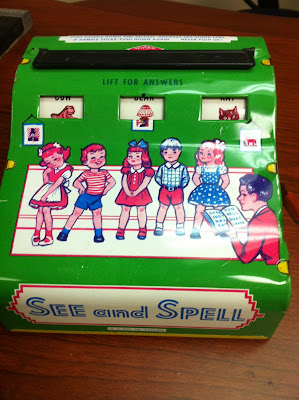
The SEE and SPELL
The SEE and SPELL
A Precursor to VocabularySpellingCity
The Game of Cootie
The Game of Cootie
Cootie Game
Cootie Game


The HsngMouse for Hangman
HangMouse
The Famous Star on VocabularySpellingCity
who  his own hangman game
Here are a list of the classic interactive games featuring the HangMouse: HangMan Online, Sound It Out, Letterfall, Word Find, and  Read a Word. 


Sunday, December 4, 2016

Vintage Telephones in My Office and Home

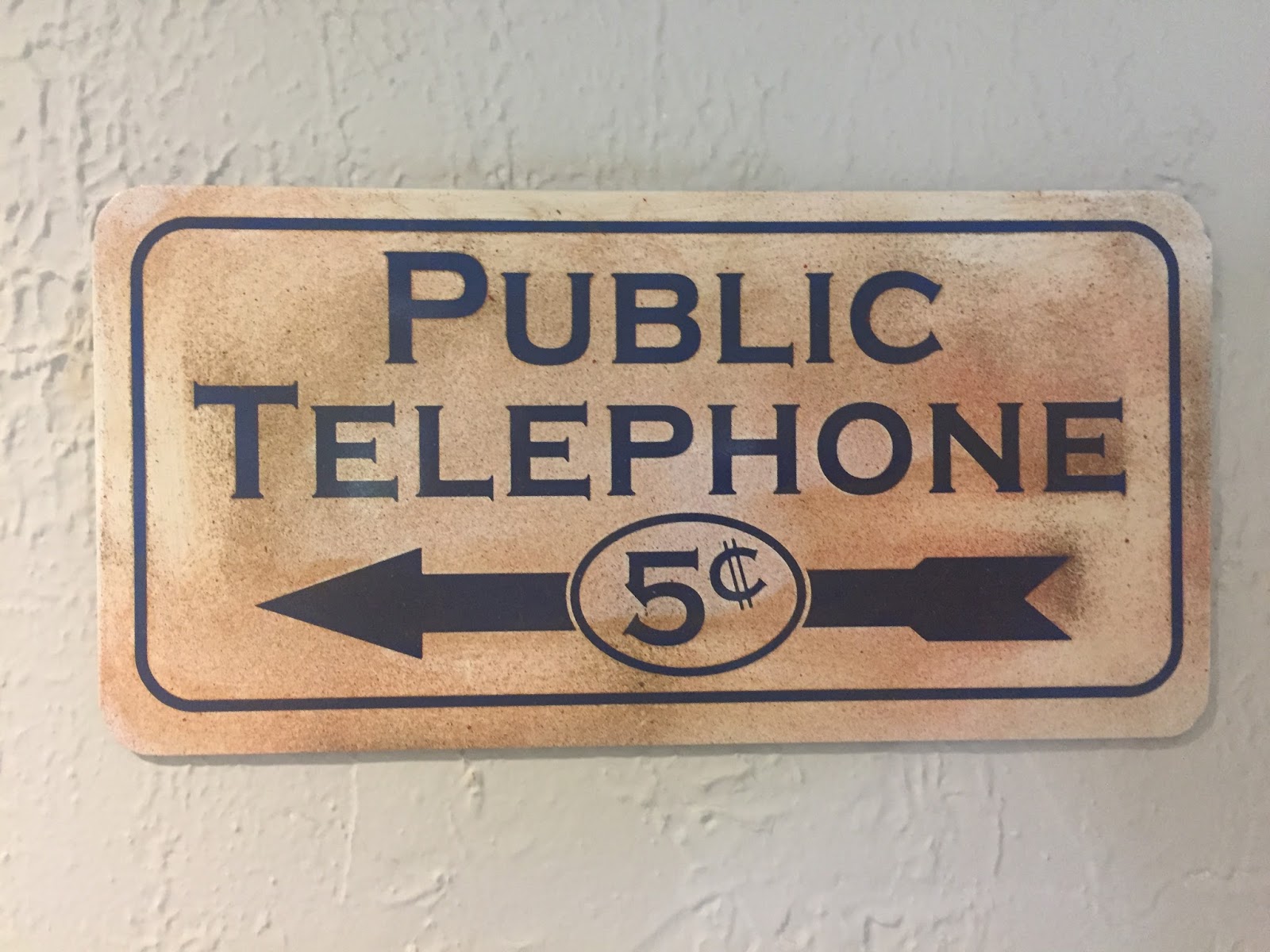
In our office, a new (to us) sign for a telephone recently appeared:


If you follow the arrow, you arrive at this phone which sadly, is not currently connected to anything:

"New" Phone in our Office

I'm so pleased by this arrangement that I've just made a quick inventory of our vintage telephonic equipment.

I have this classic candlestick phone which is pictured sitting on top of my victrola (actually, it's in my house, not in the office, but I think that still counts are part of the RetroEdTech collection):

Classic Candlestick Phone

There's this odd Scandinavian phone which weighs about a ton and which I use to have connected to the phone system.  It's an old dial rotary phone with a very visible pair of bells. Over a decade ago, someone in my house clipped its wires (don't ask, it's an xwife story...). 


I have this nice 1960's dial rotary phones made for ATT by its subsidiary Western Electric. It has that nice mid Century modern look.  


Want to see a vintage phone that looks like this but which uses more old fashioned colors?
  
And lastly, and it's a bit of a non sequitur, here is a model of the first geosynchronous communications satellite to be placed in orbit.  What it has in common with the telephones is that it was part of the telecom communications revolution and its in my collection.  The plaque on the base says:

"SYNCOM
 The first synchronous orbit communications satellite. 
Built by the Hughes Aircraft Company 
for the National Aeronautics and Space Administration. 
Launched from Cape Canaveral, 9:33 am, July 26, 1963."


Syncom 1963 - Satellite
Syncom 1963 
The reason that I have and treasure such a thing is that Burton Edelson was my dad so I grew up on dinner time conversation about the march of technology and how it was changing communications and the world. We regularly discussed geosynchronous orbit at dinner. I'm embarrassed to say that I don't remember the exact altitude at which this is a stable orbit.  


Burton Edelson Plaque on Syncom Model  Satellite
Syncom Model Plaque for Burton Edelson

Saturday, January 9, 2016

Card catalogs

It seems just like yesterday that I was going to the library, looking up books in the card catalog, and seeing where they were cataloged based on the Dewey Decimal system. Now, it's all obsolete and gone. But, not to worry, these memories will be kept alive in the RetroEdTech museum at the VocabularySpellingCity headquarters. This past week, courtesy of a local school, we obtained an original old style school library card catalog.
School Library cart catalog
Card Catalog


These card catalogs enabled students to look up books by subject, author, or name and then locate them on the shelves using the amazing Dewey Decimal System. The Dewey Decimal System is a library classification system developed by Melvil Dewey in 1876 and regularly revised since then. The Decimal Classification introduced the concepts of relative location and relative index which allow new books to be added to a library in their appropriate location based on subject. The classification's notation makes use of three-digit numbers for main classes, with fractional decimals allowing expansion for further detail.

Do you follow the TV program, the Big Bang Theory? If you do, you've probably noticed that Sheldon's and Leonard's room features a card catalog in back.  I keep wondering when it's going to become part of the plot.

Card Catalog in Sheldon & Leonards Room
The Media Centers of old, prior to the digital revolution were packed with both reference and literature materials.   RetroEdTech has these posts on those topics:

Encyclopedia and Dictionaries in School Libraries


Golden Book informational books and stories were read by tens of millions:

Back Cover of Golden Books: The Golden Library of Knowledge


Sunday, August 9, 2015

Overhead Projector, Edison Old Record Player, Polaroid


Here's my most recent acquisitions for RetroEdTech.com. I drove around this weekend and stopped at a few local antique stores and wow, look what I found!

I bought an old chemistry set. I found it in a junk store and had always wanted one. I took it to my office and showed it to the science whizzes in the office. Their recommendation: get that thing out of here. Dangerous even when it was new. Now, with expired chemicals and really old containers, and a number of pregnant women in the office; NOPE, get it out of here. So I did. Sigh.

After lots of searching, I finally bought an overhead projector on Ebay. We used these through school and college and through half of my professional career (if you are sharp you can figure out my age from that!).
Overhead Projector for Transparencies


I also bought in a junk store a really old record player. It's not really a record player since the "records" are rolls. I think it was the original device invented by Edison. I haven't had a chance to really try it or research it yet but I'm super psyched. It's called Edison Gold Molded Records.

Edison Gold Molded Records
Edison Phonograph Cylinders

I started reading about it on the University of California website. Here's a little info:

The "Gold-Moulded" process, developed in 1902, significantly ameliorated these limitations (ed: uneven quality, limited number of quality copies etc). The process involved creating a metal mould from a wax master; a brown wax blank could then be put inside the resulting mould and subjected to a preestablished and precisely calibrated level of heat. As the blank expanded, the grooves would be pressed into the blank, and after cooling, the newly moulded cylinder could be removed from the mould. The "gold" from its namesake is derived from the trace levels of the metal that were applied as a conductive agent in creating the initial mould from the wax master.
With Edison Gold-Moulded cylinders, playback speed was standardized at 160 revolutions per minute (RPM). The number of grooves on gold-moulded cylinders remained the same as for brown wax cylinders, at 100 TPI, or threads per inch.

I've also bought this weekend two more school desks.


And a very old Polaroid Land Camera with a big old fashioned flash.  A special call-out and thanks to Neil of JamesRoss Advertising who is a valued subcontractor for us and who found and donated this treasure to the collection.
(PS His firm is in no way responsible for the design of this blog. That is entirely my fault!)


Although I didn't buy it, I did take a picture of this old movie projector from a theater in Colorado that I visited last week. I did try to buy the equipment but apparently, it's not for sale.  Of course, I can't wait to get onto Ebay and see what is possible.


Lastly, I have bid on a number of old telephone switch boards on Ebay but I haven't bought one yet. Stay tuned for that too.

Monday, June 1, 2015

Record Players in Every Classroom

When I was in school (the 60s and 70s), there was a record player in a beige box in every single classroom.

This one is a Newcomb solid state record player. There are three speeds: 33, 45, and 78. The 33 was the dominant speed used for LP (long play) full size records. The 45 and 78 were used for little records or "singles", as in a single song.

It is my impression that every classroom that I was in had the same model. This was my impression, does anyone have any statistics on whether it's true? Did Necomb just have a dominant market share in my part of the country (DC) or did they have record players in every classroom in every school nationwide? Or were there multiple vendors of beige record players in a box?

I think these were a standard in classrooms right up to the end of the century (I can't tell you how weird it is to say that about the year 2000!).

The record players were often used as the sound track with the educational filmstrips that were also in use at that time.  While the record player stayed in the classroom, the filmstrip projector, hte movie projector,a nd the overhead projector were kept in the AV closet and brought to our room on the AV cart by the AV aides.


Friday, March 27, 2015

The Thinking Machine circa 1961

This film is very late 50s, early 60s. Black and white, there's an actor talking to an MIT Professor about digital computers about these new "thinking" machines. The words computer and digital were very exotic at that point.

It's from the “Tomorrow” television series produced by CBS for MIT for MIT’s Centennial in 1961.  Film courtesy of http://techtv.mit.edu/videos/10268-the-thinking-machine-1961---mit-centennial-film

Wednesday, January 28, 2015

The Poky Little Puppy

Poky Little Puppy Golden Book
The Poky Little Puppy Golden Book
When I was little, my mom would read me this story or sometimes, she would put on the record of the Poky Little Puppy. I remember it as a gem of a book.

As  look around the web, I realize that this little book is extremely well-known.  Many sites include this same phrase:

One of the original 12 Little Golden Books published in 1942, The Poky Little Puppy has sold nearly 15 million copies since 1942, making it one of the most popular children’s books of all time. Now this curious little puppy is ready to win the hearts and minds of a new generation of kids...It written by   Janette Sebring Lowrey and illustrated by Gustaf Tenggren.
"Don't Ever Dig Holes Under this Fence"  from The Poky Little Puppy
"Don't Ever Dig Holes Under this Fence"
from The Poky Little Puppy

My memory of parts of the book runs deep:

And when they got to the top fo the hill, they counted themselves: one, two, three, four. One little puppy wasn't there...

"Now where in the world is that poky little puppy?" they wondered. For he certainly wasn't on top of the hill....

And down they went to see, roly-poly, pell-mell, tumble-bumble, till they came to the green grass...

"So you're the little puppies who dig holes under fences!" she said. "No rise pudding tonight!" And she made them go straight to bed."

See related articles on Little Golden Books and Big Little Books.

Thursday, November 27, 2014

School: a noun and verb but not an adjective?

I've spent a lot of time recently thinking and talking about the word 'school.'  In a meeting , I insisted that the word 'school' could be used as an adjective. (BTW, I run VocabularySpellingCity where I have also blogged about School: Can it be an adjective?)
What sort of bus? What describes the bus?

I was in disagreement with a language arts teacher. She had close to three decades of teaching experience and was arguing that "school" could only be a noun. She had set up a multiple choice question asking what part of speech "school" was. I argued that there were three correct answers and that it was archaic form of question (Parts of speech should only be asked about a word where it is shown used in context and even then, it's ... well, that's another topic).

I spoke with some confidence: "What about "school days", "school bus", "school boy", and "school books"? What sorts of books would these be? They are school books. And besides, let's pull up Merriam Webster and I'll show you....Wow, I'll be....Merriam Webster lists 'school" as a noun and a verb but not as an adjective!  OK, lets try another dictionary..."  The same thing!  I was stupified, stumped, flummoxed, and dumbfounded.

The first two dictionaries that I pulled up both listed 'school" as a noun or a verb, (ie "Would you like to be schooled in the use of dictonaries?); but neither acknowledged the use of "'school" as an adjective.
Dictionary.com Entry

Finally, I found dictionary.com which mentions the use of school in three ways: noun, adjective, and verb.  This seemed obvious to me but I was now aware that there was room for disagreement.

What to make of Merriam Webster? What do they think about the 'school bus'?

Merriam lists 'school bus' as a noun. ("School Bus." Merriam-Webster.com. Merriam-Webster, n.d. Web. 27 Nov. 2014. <http://www.merriam-webster.com/dictionary/school bus>). In this format, they presumably consider it to be an open form compound word. Open Form Compound Word? VocabularySpellingCity explains half-way down the compound word page (BTW, I might have had a hand in writing the page, I don't really remember): 

Open form Compound Word: The words are open but when read together, a new meaning is formed. EXAMPLES: post office, real estate, full moon, half sister.

Which brings me to the point: 

When is a word a compound word and when is it just an adjective with a noun?  
School Desk, a type of desk?


The answer lies in this concept of whether a new meaning has been formed.

Real estate. I would agree that real when used with estate forms a new meaning that is not clear from just thinking of real as an adjective.

Post office is not really a type of office at all, it's a type of retail outlet so it's clearly a compound word and not an adjective noun combination. 

Full Moon?  But could full be an adjective describing the moon?  For me, the answer is no since the moon does not fill up at all like a glass or gas tank. Fullness, in this case, is a weird metaphor so for me, there's a new meaning when the words are combined. Hence, full moon is a compound word. Still, this one is a little gray since there are degrees of fullness of the moon which in my mind, tilts it back towards being an adjective with a noun.

Post

So, back to school:

Is a school bus just a type of bus?  IMHO Yes.
Is a school book just a type of book?  IMHO Yes.
What about a school desk, is it a type of desk?   IMHO, Yes.
Is school work just a type of work?  IMHO Maybe.
Is a school house just a type of house? IMHO NO, it's not a house at all. 
Is a school boy or a school girl (btw, that's one of the most searched terms on the internet....don't ask...uhg) just a type of boy or girl?  IMHO Maybe.
School day? A type of day? Maybe
School half day? This is an expression we throw around. Is Wednesday before Thanksgiving, a school half day?  Is half day a single open form compound word? What about school half day?

So there's some black and white cases of school being used as an adjective such as with bus or book. There's some definite compound words made with the word school such as school house. And there are some gray areas where I'm not sure and I'd have to consult greater authorities.  But, if Merriam Webster is unwilling to acknowledge that school could ever be used as an adjective then I (the Mayor of VocabularySpellingCity) am getting a little unsure of who this greater authority will be.  Maybe my Mom or brothers, all of whom seem to know grammar so much better than me. 

Of course, none of this matters. As the Common Core implies, students can become great writers and readers without knowing how to categorize parts of speech or diagram sentences.  And since teaching semantics and grammar does not really seem to be lighting up the student population or improving literacy, lets try de-emphasizing it. I'd agree that only the word nerds among us would care about the above discussion and so trying to teach it and get students to care about it is not the future of education.    

Or...maybe...there's other views.  Anyone?

About this blog. This blog is a personal blog of John, the founder of VocabularySpellingCity. Currently, this blog highlights vintage educational technology which have been collected in the VocabularySpellingCity office such as school desks, Golden Books, Dictionaries and Encyclopedias,  mimeograph machines, and film strips (is it just me or does every title in that list taunt me to classify it as to whether it's a compound word or not). 

 This post is a throwback to an earlier era on this blog when Miss Suzy, a colleague, wrote about language with popular article such as:  
S.O.S. -- Abrasion vs. Cut vs. Scratch
Are you Prominent, Eminent or Either or Neither?
Estimate and Esteem
Clean Up Your Use of Guest.