Thursday, July 23, 2020

Elementary Students: Owning the Learning?

 One of the brightest trends that I see in education today is a broad nationwide move to have students own their learning and to adopt a growth mindset. I’m particularly encouraged to see that this is a distinct trend in elementary schools.


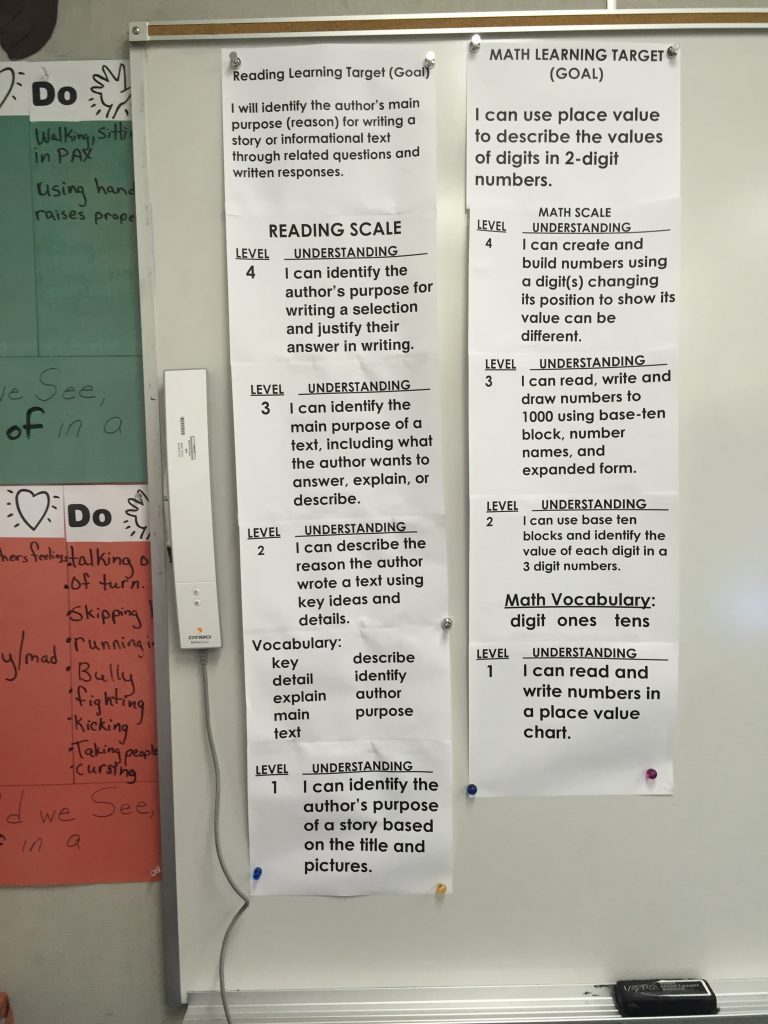
Learning Goals – Standards – are Posted

In school after school, in Twitter chats, during conference discussions, and in other online sharing, I hear principals and teachers citing details that convince me that this is a broad-based approach.  And it’s really healthy.  Since student empowerment was one of the founding principles of VocabularySpellingCity, I take just a little pride in the fact that we are helping to push this trend forward.

Here are a few places that I see the trend:

In many schools, students are made aware of their educational goals each week.  It’s important that teachers set goals for the class and share them. The students are encouraged to understand the goals, why they are important, how the skills will be built, and how they will be assessed.


Four Levels of Proficiency are Posted

In an increasing number of schools, each week, teachers are posting not only the standards their students will be working on, but they also establish four levels of proficiency for each standard. These seem to be adopted from Webb’s Depth of Knowledge.

The Four Levels of Proficiency are posted in the classroom as a matrix featuring the standards, ways to demonstrate proficiency, and a hierarchy of levels of proficiency.  In some classrooms, there are four sets of standards each week: language arts, math, science, and social studies.

VocabularySpellingCity and Student Ownership of Learning


Four Depths of Knowledge for a Weekly Learning Goal

As I mentioned above, one of VocabularySpellingCity’s original goals, back when we were just SpellingCity, was to empower students to be able to learn on their own. It’s hard to study spelling independently without a tool like VocabularySpellingCity. I published an article on Students Being Able to Own their Learning on their original SpellingCity Forum (now long gone) and then revisited this idea in the October 2015 blog post cited above.

More importantly, as VocabularySpellingCity focused on its mission of improving reading comprehension outcomes by helping students build vocabulary, we identified the importance of enlisting students in the strategy of building vocabulary retention  (see paragraph 5) as a key step in the system.

Students can catch up, keep up, or stay ahead of their grade level by using our activities with our ready-made grade level lists for vocabulary and spelling. For example, this 2nd grade spelling word list gives 2nd grade students (or ambitious first grade students!) the opportunity to test their skills and see how many of these grade-level words they know.

These premade grade-level lists help students figure out what’s expected of them, and how they can continue to improve. Alternatively, letting students create their own lists can also be a great way to help them get motivated.

Most recently, I’ve written on how letting students create their own lists on VocabularySpellingCity helps encourage students to take control and ownership of their learning.  I’ve also detailed how teachers can implement this by changing a single setting in their accounts.


If any of you have examples of how students are owning the learning in your classroom and/or photos to share, please send them along. I’ll retweet and post!

Words That Don’t Mean What They Say – Idioms!

 Tim Rasinski is a renowned professor of literacy education whose research on reading fluency and word study has made him a literacy hero to many. Below, he shares his thoughts on teaching idioms.

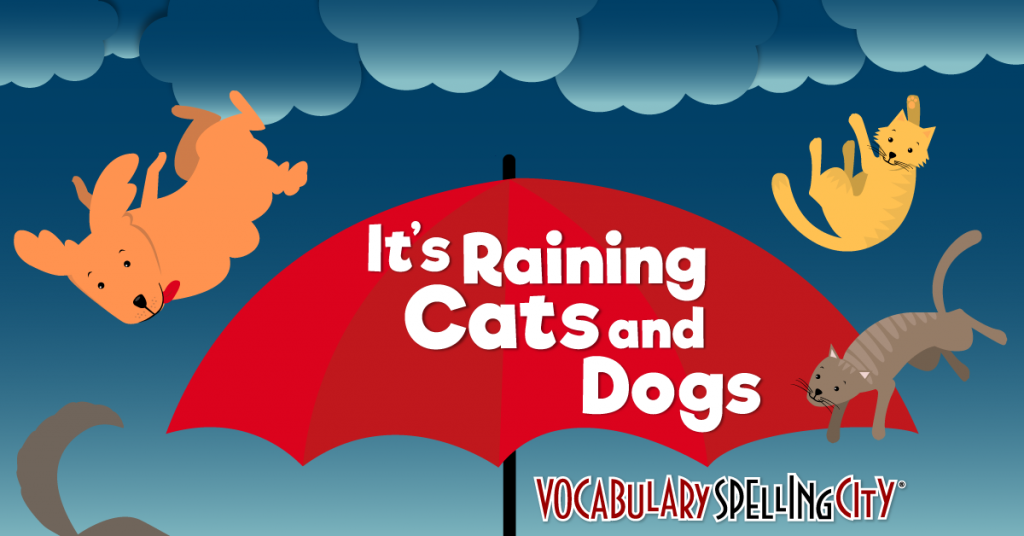
It's Raining Cats and Dogs is an idiom that means a hard rain.
An idiom is an expression whose meaning is different from the literal meaning, like “It’s raining cats and dogs.” Find more idiom resources on VocabularySpellingCity.

Some of the most challenging words (and phrases) for students to learn are those that are metaphorical in nature – words not meant to be taken literally.  Idiomatic expressions, a type of figurative language, are among the most challenging words for students to learn. Expressions like going bananas, it’s raining cats and dogs, a chip on your shoulder, and it’s all Greek to me, are not to be taken literally.  The meaning of these expressions is hidden. It is up to the listener or reader to understand the underlying meaning of such expressions. Whether written or spoken, idiomatic expressions are common. Authors use idioms to make their writing more interesting and authentic.

Yet, unless the reader understands the hidden meaning of the idiom, s/he will have difficulty understanding the text in which the idiom is situated. Given the importance in understanding idioms, it seems reasonable to expect that figurative language, and idiomatic expressions in particular, be an integral part of a reading/language arts curriculum. However, if you take a look at reading and language arts instructional programs, you will find, at best, only a limited amount of coverage in any such topics. So what to do?

There are literally hundreds of idioms that are worth teaching. One approach that I might suggest is to teach idioms by themes or topics. At the beginning of the week, identify a theme that contains a number of idiomatic expressions. The website The Idiom Connection has organized expressions by theme. There you will find themes such as clothes idioms, animal idioms, number idioms, sports idioms, and more. Select (or ask your students to select) 8-10 idioms that belong to the chosen theme. Display these idioms on a chart along with their underlying or hidden meaning. Below is a chart for dog idioms.

Keep the display up throughout the week and encourage students to use the displayed expressions in their own oral and written language. For example, you might ask students to use at least one idiom in their personal journal at the end of each day. Of course, if you want students to use the expressions, you’ll need to find ways to use them yourself. For example, if a student provides an incorrect response to a question, you might say that he’s “barking up the wrong tree,” or if you don’t think the school principal will like an idea you might say, “well you just can’t teach an old dog new tricks,” or if you have a group of students who are “hounding” you with a request, you might tell them to “call off the dogs.” As you can probably see, finding ways to use these expressions is a fun challenge for both you and your students.

After having playfully used the idioms throughout the week students will probably have a good understanding of them. But if you want to take it one step further, at the end of the week ask students to work by themselves or with a partner to write a paragraph or two that summarizes the work done over the week or the plans students might have for the weekend and embed as many of the week’s expressions as possible. Here’s an example of what one student wrote recently:

“My sister and I have been hounding our parents to take us to the high school football game this weekend. Since he didn’t want to be in the doghouse, Dad finally told us to call off the dogs –  he agreed that he would finally take us. However, since it is supposed to rain cats and dogs this weekend, we think we might ask Dad to let sleeping dogs lie and wait for another day to take us to a game.”

Can you imagine the fun of having students read and discuss their short compositions with their classmates on a Friday afternoon? Moreover, you can save the very best essays to share with students in the following school years. Learning to read and learning words should be fun. Bringing idioms into your classroom is sure to add joy and authentic learning to your classroom experience.

(links to resources removed)

_________________________________________

Tim Rasinski is a professor of literacy education at Kent State University. His research on reading has been cited by the National Reading Panel and has been published in journals such as Reading Research Quarterly, The Reading Teacher, Reading Psychology, and the Journal of Educational Research. Read more about Rasinski here. or connect with him on Twitter @timrasinski1.  

Rasinski’s research on word fluency is cited in the report, “Applying Best Practices For Effective Vocabulary Instruction,” written by VocabularySpellingCity in partnership with McREL International.

Vocabulary: Shades of Meaning

 ince building student vocabulary skills is one of the big development areas for our company, I’m thinking a lot about how to build elementary vocabulary skills in a more rigorous and nuanced fashion.

Today, I’m writing about nuances of meaning but more generally, I’m studying the needs and standards and trying to identify ways that we can help schools practice and build vocabulary skills. Starting point: Do you have unmet needs in your schools for a supplementary, technology-based language arts program to help build vocabulary skills? If you would like to help us figure out how to help you, I’d like to hear from you. Email me at mayor@spellingcity.com.


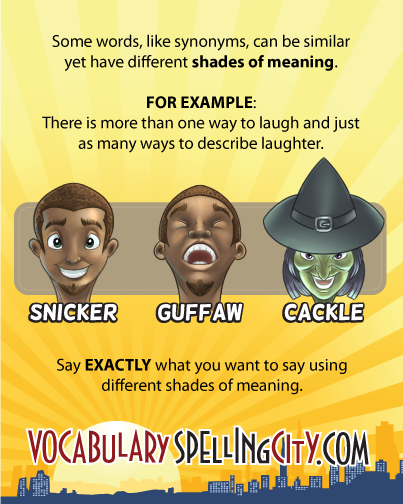
I love that the modern language arts standards emphasize shades of meaning and de-emphasize synonyms.  I always thought in school (and since) that it’s naive to teach that snicker, guffaw, and cackle are synonyms. Yes, they all describe laughter, but they do NOT mean the same thing. We all know that they mean slightly different things, so I’m pleased that instead of identifying them as synonyms, we now focus on the differences and really, what these words mean.

Core standards say that in kindergarten, students should get to act out the shades of meaning between different verbs. We will soon be providing an array of verbs that kindergarten teachers can give to students to act out. I only wish I had more time to spend in the classroom watching how much fun this is going to be, and how it will help give students a solid foundation in language concepts.

In second grade, the core standards add in adjectives: Distinguish shades of meaning among closely related verbs (e.g., toss, throw, hurl) and closely related adjectives (e.g., thin, slender, skinny, scrawny).

By third grade, they make it more conceptual to address states of mind.  But they also introduce “degrees of certainty”: Distinguish shades of meaning among related words that describe states of mind or degrees of certainty (e.g., knew, believed, suspected, heard, wondered).

Notice that they do not call out or emphasize the relative distinctions such as: fast, faster, fastest. I believe it’s because while this has been a standard lesson in many classrooms and textbooks, it is an example of a dumbed-down lesson which the standards feel are inadequate in building critical thinking and linguistic skills. However, when I look at many of the vocabulary materials available, I see an inordinate focus on comparing the shades of meaning along a specific criterion.

Notice also that the example called out by the standards in third grade – the states of mind – gets students to reflect on their own states of mind. Rather than the old simplistic distinction between fact and opinion (and fiction), the standards emphasize the complexity and subtlety of all the shades of knowing or thinking.

By fifth grade, the nuances of meaning are no longer being called out, and the standards talk generally about word relationships: Use the relationship between particular words (e.g., synonyms, antonyms, homographs) to better understand each of the words.

So that’s a quick walk-through of the standards related to shades of meaning. Any thoughts on a best practice for a supplementary language arts program to help practice and build vocabulary skills in this or other areas? If so, reach out to me.  Twitter works too: @VSpellCityMayor

Vocabulary: Superpower or kryptonite?


Keys to Vocabulary Success

 Vocabulary is responsible for 70% of reading comprehension problems in elementary schools. And while the research is clear on what most students require to build vocabulary (12 spaced multimodal encounters with a word), many schools ignore the research and reading scores suffer.  Research shows that with the right techniques for word study used ten minutes a day,  reading comprehension can improve by one fifth. It’s proven, low cost to implement, and takes no additional time during the school day.

*     *      *      *

Vocabulary is responsible for 70% of reading comprehension problems in elementary schools.  (source: National Research Council study, 4th graders).

Improving elementary students’ reading comprehension by building vocabulary retention is our mission.   The challenge that we see across the spectrum of elementary schools and students is consistent: it’s vocabulary. In some Title I schools and schools with ESL populations, it can be Tier I words. In general education and for everyone, it’s Tier 2 words with content and academic vocabulary. No matter where the school is located or type of students, vocabulary is a problem.

A problem is that many schools ignore the research on vocabulary retention strategies.  They are also ignoring common sense.  We all know that “learn it for Friday’s test, forget it by Monday” is a common problem.  Why bother teaching all those words if the students are just going to forget them? Some schools have actually dropped explicit vocabulary instruction (#BadIdea!) adopting the wishful and wrongful thinking that if their students read enough, they’ll absorb the vocabulary that they need. Mostly, this isn’t true.

The research is clear: Twelve to fourteen spaced multimodal encounters with words is the recipe for retention.  Here are the key  and necessary ingredients again:

  1. Spaced practice over four weeks. Not lots of practice over one week.  Over FOUR weeks.
  2. Multiple encounters.  Not 3, not 7: the research says 12-14
  3. Multimodal.  Just reading a word does not work. Read, write a sentence using each word, break it down by sounds  or word parts,  count the syllables,  play games with it, say it, and read it again.

I’m going to add a fourth ingredient to the mix.  Fun. Engagement. Word practice can and should me amusing and engaging. Make your classroom a funeteria. Or a funaterium. And while you are making up words as a way to make those pattern recognition engines (ie your students’ brains) work, you might also speak in rhyme, work with rhythms, sing, dance, and otherwise infuse you and your students’ days with games, joy, and engagement (more on this later. Thanks to Dr. Tim Rasinski for reminding us of the importance and possibilities for joy and how we must fight to keep study from becoming grim!).  I digress but by far my favorite part of the CCSS is that starting in kindergarten, students should act out nuances of meaning. I love the idea of classrooms full of students walking / dancing / slithering / marching / sauntering / sneaking and otherwise crossing the room.

Before we get back to the research on vocabulary research, there’s a common confusion about vocabulary that I’d like to clear up.  The vocabulary that’s important to learn is not the fancy esoteric elitist $5 SAT-type vocabulary words like supercilious, engender, harangue, obdurate, or ensconce.  The important vocabulary words are the Tier 1 & Tier 2 words that are in common usage (often ESL students or students from language deprived backgrounds need exposure here)  and the academic and content vocabulary that are the keywords to learning.  For instance, many key science and social studies concepts are accessed through vocabulary words such: river, current, lake, delta, fresh water, brackish water, salt water, ocean, tide, and waves.  When students learn these important concepts (ie a river has current), their ability to retain them are related to the label or vocabulary word for these concepts

Research Based Vocabulary Study – Lets start with Spaced Practice:


Vocabulary Retention Enabled Through Spaced Practice

The teachers teach ideas and concepts on a weekly cycle. The next week, they need to move onto a new topic and too often, the previous weeks vocabulary lessons and words fade away.

Here’s the concrete steps for a school or district to building a system for improving comprehension by revisiting the concepts and vocabulary over four weeks:

  1. Train the teachers and the students.  Teachers should understand  the impact of paying some attention to vocabulary retention.  The training should extend to the students so they too understand that the point of the vocabulary study is long-term retention, not just getting through each week’s cycle. Spaced practice, in which the students encounter these words over multiple weeks in different contexts, greatly increases the probability of retention.
  2. Use a multimedia game-like system so that the students are truly engaged. It’s important that they can hear the words and see them used in context. Play with them. Figure out what they mean. Write with them. VocabularySpellingCity has been designed specifically to provide this spaced multimodal practice with over 35 different learning activities and games covering from writing sentences for each word to breaking each word down phonetically, from vocabulary to spelling. This variety is important if the students are going to work daily on the system.
  3. Use VocabularySpellingCity’s system with reports for teachers, for parents, and for administrators.
    • Assign activities and lists, rather than simply letting students play.
    • Look at the recorded data and hold students accountable for both their level of effort and results.
    • Leverage students’ reading by asking them to harvest 10 interesting words and create a list on VocabularySpellingCity. Then you can share the list with other students, and the students can teach the words to each other. (If you don’t know about student-created lists, you’re missing a key feature.)
  4. Measure your progress. As you implement a program for increased vocabulary retention, establish a metric for measuring it either directly or through improved comprehension. One of the trends that needs to be refined in schools is to use testing to encourage and guide success. The point should be formative assessment that’s useful, not high-stakes testing that is so brutal and apparently ineffective.

If you’re interested in the research, there’s a downloadable white paper created by VocabularySpellingCity and McREL International about the field study and another on the academic research behind this approach. Better yet, if you’re interested, give us a call at (800) 357-2157 or contact us online. We can set up your district, school, or classroom rapidly, including plans for ongoing professional development and for measuring your students practice. Let’s work together to make vocabulary your students’ superpower!


Our Journey to Vocabulary

 Many users have noticed that our service transitioned from being spelling-based to this new focus on vocabulary

retention to build reading comprehension. Read about  Our Journey to VocabularySpellingCity. I think many schools and teachers are also transitioning along similar paths. The summary is that from our SpellingCity’s legacy, we remain committed to gamification, student empowerment, and teacher productivity.  It is on this foundation that we built a system for vocabulary building  fully aligned with today’s highest priority in education: improved comprehension.

The critical missing element in building comprehension (verbal and reading) is vocabulary and VocabularySpellingCity is on mission to spread the words about the importance of implementing effective vocabulary retention techniques in classrooms.